





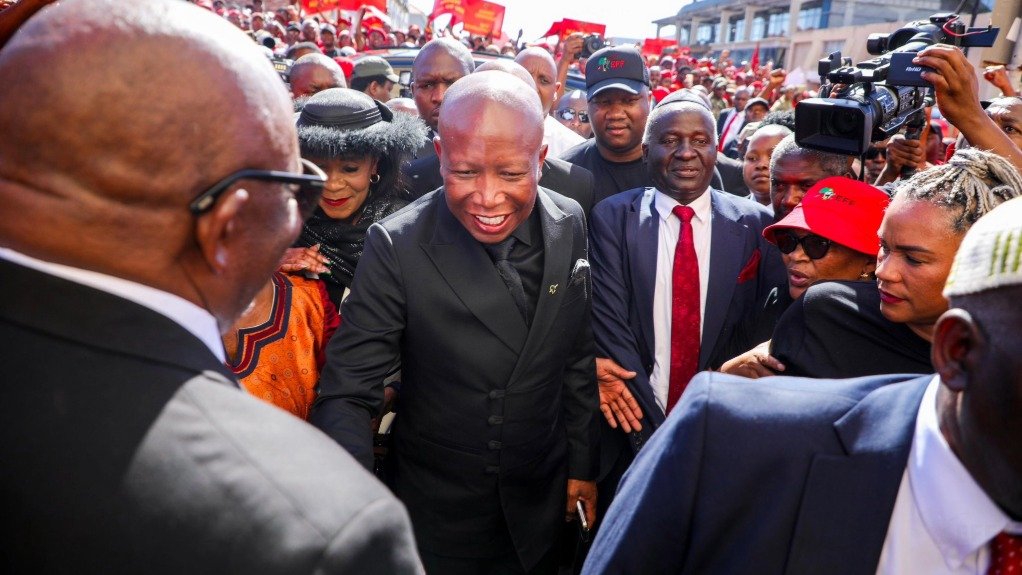
Thousands of supporters of South African opposition politician Julius Malema gathered outside a court on Friday as the Economic Freedom Fighters (EFF) party leader awaited sentencing for firing a rifle in the air at a rally in 2018.
A prison sentence exceeding 12 months, upheld through all appeals, would disqualify Malema from parliament - a blow to the EFF, which is popular among young South Africans critical of government efforts to address racial inequalities that have persisted since the end of white minority rule.
He faces a possible prison sentence of up to 15 years, but could be given a more lenient sentence, such as community service, if the court thinks there are mitigating factors.
The 44-year-old politician was convicted in October of charges including unlawful possession of a firearm and discharging a weapon in a public place. He had pleaded not guilty, arguing the gun was a toy.
It was unclear whether the sentencing would happen on Friday but supporters outside the East London Magistrate's Court held aloft placards reading "We stand with Julius Malema," many wearing the EFF's trademark red berets.
MALEMA COULD BE BARRED FROM BEING A LAWMAKER
The far-left EFF - the fourth-biggest party in parliament, with 10% of seats - advocates nationalising mines and seizing land from white farmers.
Independent political analyst Melanie Verwoerd said the EFF would struggle without him, citing opinion polls that show people strongly associate the party with Malema, one of South Africa's most prominent politicians.
Malema featured in a tense White House meeting last year, when US President Donald Trump confronted South African President Cyril Ramaphosa with explosive false claims of mass killings of white South Africans.
Trump played Ramaphosa a video of Malema singing the liberation chant "Kill the Boer" and suggested he should be arrested.
Afrikaner lobby group Afriforum, which pushed for charges against Malema over the 2018 firearm incident, argues the chant is an explicit call to murder Afrikaners, descendants of predominantly Dutch settlers.
South Africa's courts have ruled against attempts to have it designated as hate speech, on the basis that it is a liberation struggle song, not a literal incitement to violence.
EMAIL THIS ARTICLE SAVE THIS ARTICLE FEEDBACK
To subscribe email subscriptions@creamermedia.co.za or click here
To advertise email advertising@creamermedia.co.za or click here

