





CAPE TOWN (miningweekly.com) – A strong sustained positive commodity cycle is on the way, and South Africa should go all out to take full benefit from it for the benefit of the South African people.
To make the best of what is seen as a major new opportunity for South Africa, government should ensure a regulatory environment that is enabling, electricity competitiveness should be assured and the way should be opened for exploration to take place in the near term.
These were among the points made by Minerals Council South Africa president Paul Dunne, who is leading the mining industry through regulatory shifts that will promote investment in exploration and mining. Dunne, who is also the CEO of Northam Platinum and who served as caretaker president in 2024, was officially elected at the council’s 135th AGM in May 2025.
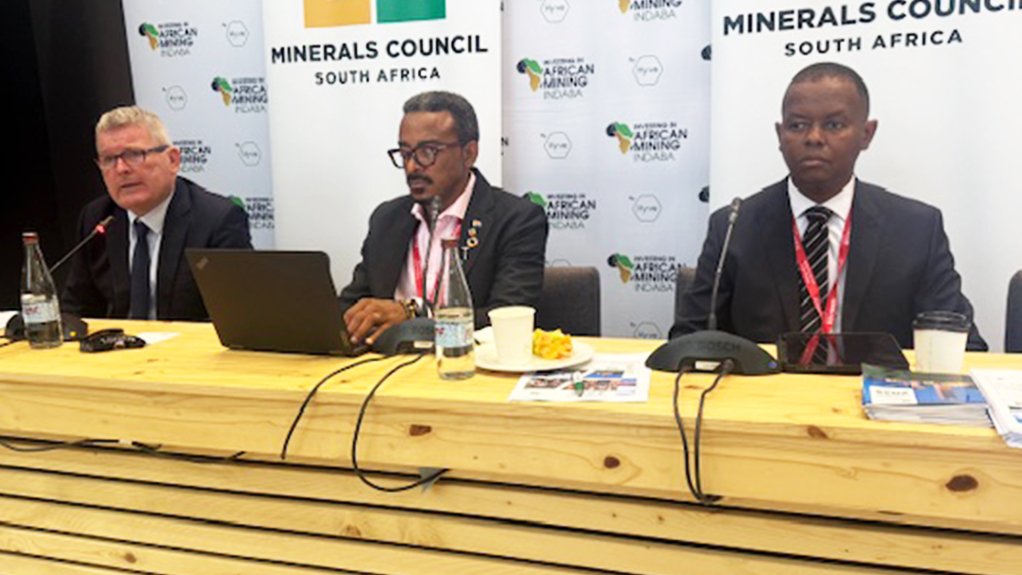
“It's a personal view, but I do think South Africa is in for a strong multi-year commodity cycle and not, as you might say, a flash in the pan,” Dunne outlined during a key media briefing on day-one of this year’s well-attended Investing in African Mining Indaba in Cape Town, which is being covered by Mining Weekly.
“The question, of course, that’s certainly in our minds, is will we be able to take full advantage of a commodity cycle such as this? We’re certainly going to be advantaged, but will we be able to take full advantage?”
“There are still hurdles and obstacles that we're working on to improve our lot. The team at Minerals Council South Africa is a very dedicated bunch of quite quiet people.
“In many respects, what they do is often hidden in the sense that it's a lot of hard grind behind the scenes with government departments. In essence, what Minerals Council South Africa is doing is grinding out better outcomes on some very difficult issues.
“The issue that is foremost in our mind is the Amendment Bill,” in reference to the 2025 draft Mineral Resources Development Bill, which aims to amend South Africa’s Mineral and Petroleum Resources Development Act of 2002.
“We were disconcerted by what we saw in the Bill and we hadn't yet got access to the regulations that support the Bill, and we had about five areas of broad concern.
“In the first instance, we directly engaged with the Minister and the department to express concern, and we followed that up with a very lengthy legalistic document, pointing out the good bits and raising alarm on some of the more difficult areas,” Dunne spelt out in the Minerals Council South Africa briefing covered by Mining Weekly.
Fingers are now crossed that a reformed Bill will be published in the not-too-distant future.
FERROALLOYS SHOULD BE GIVEN A CHANCE
The second crucial issue raised by Dunne is the electricity issue. “Although we've had success as a country with the security of electrical supply, the cost of electrical supply has arisen by a very substantial amount of somewhere between 800% and 900% over the last ten years or so.
“That has put pressure on the energy-intensive users, such as the ferroalloy part of our sector, and beginning with the ferrochrome and then also the ferromanganese. These smelters are very heavy users of power and one of the biggest cost inputs is the cost of power.
“Many of those furnaces are now dormant because they are not profitable in the current environment. What we have done, working with the government departments, including Minister of Electricity, together with the chrome sector, is to advise government that we need to help that sector.
“The reason we worry about tariffs and quota application is it's contagious and has potentially unintended consequences, and we also think it's a misdiagnosis of the problem.
“The real issue is the cost of power, and there is movement from Eskom under the guidance of the Ministry of Electricity to see what can be done about a preferential electricity supply tariff to help the ferrochrome industry.
“That industry employs a lot of people. It's also quite technical, so there's a lot of skillsets in there, and we feel, as Minerals Council South Africa, that it should be given a chance.
“It does seem, and this is what we have been advised by Ministry of Electricity, that Eskom now has unsold electricity, In other words, Eskom has done quite well in that the energy availability factor has risen and, as a result, there are number of gigawatts now that effectively could be generated and sold, but they're not being generated and sold because some of the big furnaces are off, so that electricity could be sold on a variable costing model, we believe, which would benefit both Eskom and the ferrochrome business.
CADASTRE ROLLOUT URGENT
Dunne’s final point centred on the urgent need for exploration, which is the lifeblood of mining, and the long-awaited introduction of a cadastral system to promote exploration.
While the proposed South African cadastre system has been demonstrated in Parliament, and is being initiated in the Western Cape, Minerals Council South Africa is calling for urgent implementation.
“An expeditious rollout to the cadastre would help us all a lot. The cadastre would provide for a transparent system, free from potential corruption, and overcome what we term over-pegging, where there are two claimants on the same mineral site.
“Again, the cadastre has been a long-standing issue and that's what I'm trying to illustrate about the nature of some of these issues. It's a really hard grind to get the end result, and that's what Minerals Council South Africa endeavours to achieve in its work,” Dunne emphasised during his briefing covered by Mining Weekly.
Minerals Council South Africa is working feverishly in the background on these issues and South Africa as a whole needs positive government response given the economic magnitude of what mining is able to offer the economy.
EMAIL THIS ARTICLE SAVE THIS ARTICLE ARTICLE ENQUIRY FEEDBACK
To subscribe email subscriptions@creamermedia.co.za or click here
To advertise email advertising@creamermedia.co.za or click here

