





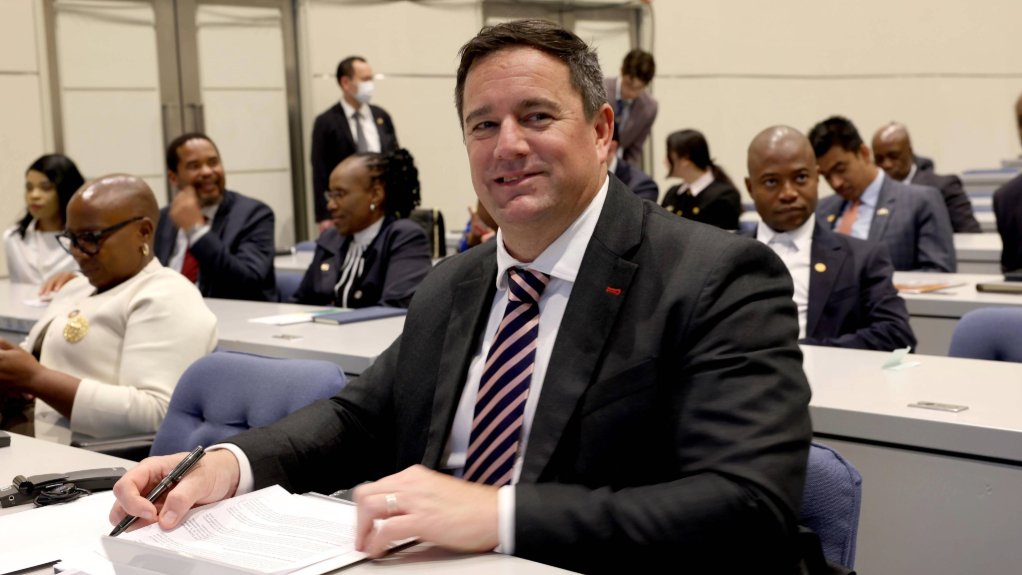
 Speculation continues about why John Steenhuisen
 The DA is the country’s main opposition party and, since elections in 2024 in which the African National Congress lost its majority, part of a government of national unity. Opinion polls show that the DA’s support has increased since the election – it’s now closer to 30% – while support for the ANC continues to fall.
The DA promotes a federal view of government, a “social market” economy and private-public cooperation.
Steenhuisen’s announcement only suggested that he wants to focus on his role as minister of agriculture.
He became the DA leader in 2019, a turbulent time in the party’s history. The party’s first black leader, Mmusi Maimane, had left. The party had suffered a decline in support in the 2019 elections, and was accused of being more concerned about losing white support to the conservative, white-focused Freedom Front Plus than about a non-racial national profile.
Steenhuisen’s decision is important for the DA, because two of the three most senior leadership positions will become vacant – the federal leader, and chair of the federal council, which Helen Zille currently occupies and which she is leaving. It is even more important in view of the national local government elections that will be held at the end of the year.
The DA is now the second biggest party in South Africa and therefore an important member of the Government of National Unity. A new DA leader will have implications for the party’s relationship with the president and other unity government members.
How he got here
Steenhuisen built his political career in KwaZulu-Natal. The province is not one of the powerhouses in the DA, but it has always been regarded as one of the potential growth points. Its advantage is that, within the DA, the province isn’t caught up in the internal power play between the Western Cape and Gauteng. That’s presumably made Steenhuisen attractive as the national leader.
His track record as a very assertive DA parliamentary chief whip also counted in his favour. But as leader of the opposition, he had to become a statesman. He inherited a failed attempt to transform the DA’s public profile into a party also attractive for black supporters. His task was therefore to lead a new strategy for the party.
The results of the 2024 elections are an indication that his leadership arrested the party’s electoral decline and introduced a period of growth among the broader South African population. Its support increased from 20.8% to 21.8%.
The DA became part of the Government of National Unity as a result of the ANC losing its majority for the first time since South Africa’s first democratic elections in 1994. It also became part of the KwaZulu-Natal provincial government of unity. In addition, it consolidated the party’s majority in the Western Cape.
But these successes also tested Steenhuisen’s leadership.
In her book on the coalition negotiations after the 2024 elections, the journalist Mandy Wiener explains that Steenhuisen played the role of the DA’s principal and therefore was not directly involved in the face-to-face negotiations. As principal he was often upstaged by two of the negotiation team members and former DA leaders – Helen Zille and Tony Leon.
More recently Steenhuisen has been accused of being too close to President Cyril Ramaphosa and of being “captured” by the ANC.
Behind Steenhuisen’s decision?
Neither Steenhuisen nor the DA has given an clear indication of why he decided not to stand again as candidate for the DA’s leadership, except that he wants to focus on his work as agriculture minister.
The reasons for his decision are therefore a matter of analysis or interpretation.
A party leader should never be uncertain about support from the main centres of power in the party. Factionalism or regionalism associated with a party leader will inevitably erode a party and its leader.
A DA leader cannot function without the unqualified support of the Western Cape and of Gauteng, because they are the two provinces that constitute the core of the DA’s support base.
Political analysts have pointed out that Steenhuisen does not enjoy the unqualified support of the Western Cape. The province is important to the party, because it controls the provincial government and Cape Town metro. Both are seen as prime examples of its success stories.
Steenhuisen’s KwaZulu-Natal did not built a powerbase for him within the party. Nor did the DA grow sufficiently in the province.
Steenhuisen’s authority as party leader was undermined last year over Ramaphosa’s dismissal of DA member Dion George as the minister of forestry, fisheries and the environment.
Steenhuisen had requested that Ramaphosa remove George for his “lack of performance” in his portfolio.
In the fallout that followed, George alleged that Steenhuisen had abused his party credit card. George also referred the matter to the Public Protector.
The events called into question Steenhuisen’s moral authority and ethics.
Lastly, as agriculture minister, Steenhuisen is struggling to bring a dramatic rise in foot and mouth disease under control in the country. Though he is one of the ministers who has done most in trying to get the disease under control, he is under severe pressure from the organised agricultural sector for the private sector to play a bigger role in managing the outbreak.
There’s a deeper policy principle for the DA at play here too, namely the private-public roles in public issues. As minister, Steenhuisen represents the role of the government department in managing the disease. But many farmers want more scope for their private initiatives regarding vaccinations and related matters.
The impact on the Democratic Alliance
Steenhuisen’s announcement affects the DA in a wider context. It means that two of the three top positions in the party will become vacant at the congress.
Only the federal chair, Ivan Meyer (member of the executive council in the Western Cape) will remain. With Zille involved in the Johannesburg metro, it will be the end of her role as the chair of the federal council. It implies a total revamp of the DA’s top structure very close to the local government elections.
The potential implications of these changes one can only speculate about. It might see the younger generation move into key positions. It might see a comeback for the Western Cape if Meyer is re-elected and Cape Town mayor Geordin Hill-Lewis comes in as party leader. It has the potential for more black people in key positions, such as Ashor Sarupen, Solly Malatsi or Siviwe Gwarube.
Finally, it has the potential to create two centres of power in the top structure if Hill-Lewis is elected as party leader but continues as Cape Town mayor. Then a parliamentary leader will have to be identified.
Irrespective of who is elected in which position, the DA’s April congress might become a major milestone in its history.
Steenhuisen’s legacy
As far as Steenhuisen is concerned, he clearly sees his future as a minister and not as a DA leader anymore. If he can gain control over the foot and mouth epidemic, it will be a major achievement for him. And his lasting legacy.
In history, he will most possibly be regarded as a transitional leader of the DA, who stabilised the situation after 2019, exploited the decline in ANC support, saw the need for alliance-building between parties at an early stage and led the DA into national coalition politics.
Written by Dirk Kotze, Professor in Political Science, University of South Africa
This article is republished from The Conversation under a Creative Commons license. Read the original article.

