





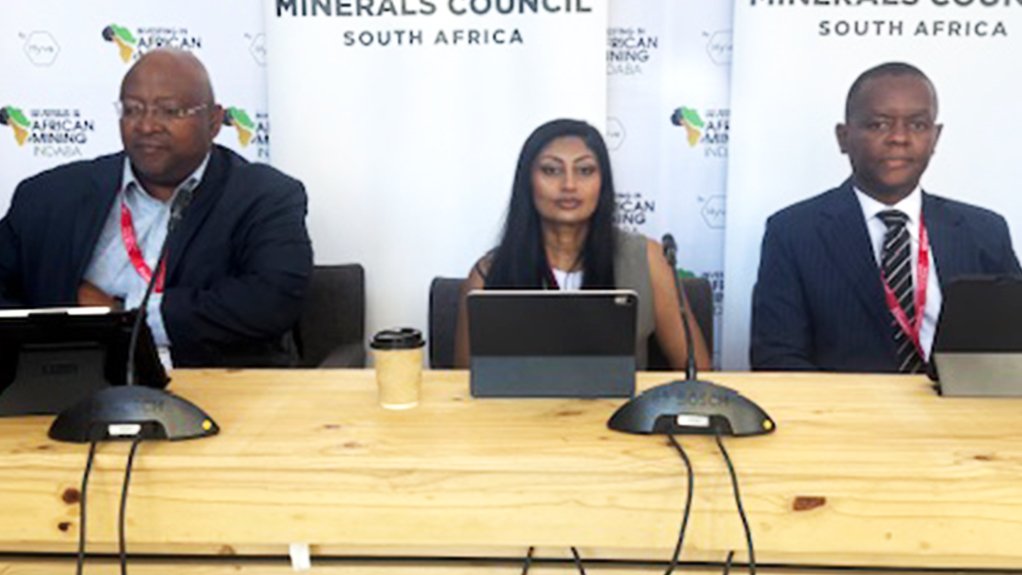
CAPE TOWN (miningweekly.com) – One of the countries South Africa can learn from when it comes to beneficiation is Finland, Minerals Council South Africa acting chief economist Bongani Motsa outlined on day-three of the Investing in African Mining Indaba on Wednesday.
Speaking on a panel with Minerals Council senior executive environment, health, and legacies Shamini Harrington and Minerals Council senior executive public affairs and transformation Tebello Chabana, Motsa noted that Finland had pursued a deliberate strategy of mineral value addition, anchored in its National Mineral Strategy.
“Finland recognised that simply exporting raw ores would not maximise economic or technological benefits, so it invested heavily in downstream processing, research, and innovation.
“Finland’s approach emphasises aligning mineral development with the EU’s critical raw materials agenda, while also building domestic industrial capacity.
“This has meant fostering strong linkages between mining companies, technology developers, and universities, ensuring that minerals are not only extracted but also transformed into advanced products for batteries, clean energy systems, and high‑tech manufacturing,” Motsa spelt out.
Mining Weekly can report that Finland’s strategy also integrates sustainability, circular economy principles, and environmental safeguards, positioning Finland as a responsible supplier in global mineral chains.
The Finnish list of priority minerals reflects both domestic geology and global demand trends. It includes nickel, cobalt, lithium, graphite, and rare earth elements, alongside traditional strengths in copper, zinc, and platinum group metals. These minerals were chosen because of their importance in battery technologies, renewable-energy systems, and digital industries.
For example, Finland has become a European hub for battery precursor production, leveraging its nickel and cobalt resources, while also investing in refining lithium and developing recycling systems for critical materials.
By focusing on value addition, Finland has moved beyond being a raw material supplier to becoming a strategic player in the clean energy and technology value chains.
Instruments used by Finland to promote the link between its priority minerals and industrialisation are a combination of policy, institutional, and financial instruments to link its priority minerals with industrialisation.
The core policy instrument is the National Mineral Strategy, coordinated by the Ministry of Economic Affairs and Employment, which sets clear objectives for value addition and integration into the EU’s clean energy and digital transition.
Motsa described South Africa’s critical minerals and metals strategy as a good start.
Institutionally, Finland’s government has invested in research and innovation ecosystems, particularly through the Geological Survey of Finland and partnerships with universities, to ensure that mineral extraction is tied to advanced processing and technology development.
“As South Africa, we already have institutional capacity, the question is, to what extend will there be a deliberate resource injection to advance the aspirations of the critical minerals and metals strategy. In fact, this takes me to an important aspect that I need to mention. Except for a few aspects including … electricity tariff funding of between R23.8-billion to R44.2-billion and the R400-million in exploration funding made by the IDC, generally the strategy is not costed,” Motsa pointed out.
Financially, Finland has used three broad instruments including public‑private investment entities innovation funding, and EU‑backed financing to derisk large capital projects. It has also embedded circular economy principles, encouraging recycling and secondary use of critical minerals to sustain industrial supply.
Together, these instruments have allowed Finland to move beyond raw mineral exports, positioning itself as a European hub for battery materials, clean energy technologies, and advanced manufacturing inputs.
Countries that have generally experienced sustainable economic growth, on average spend between 3% and 5% of GDP on research, development and innovation. In 2024 South Africa spent R56-billion which is the equivalent of 0.8% of GDP.
“South Africa’s mineral wealth is undeniable. But wealth in the ground is not prosperity in society. By focusing on beneficiation, turning platinum into hydrogen fuel cells, manganese into battery materials, iron-ore into steel, coal into chemicals, and chrome into stainless steel, South Africa can transform its economy. All to solve the country’s problems - then we will be beneficiating for the right reasons.
“The choice before us is clear: remain a supplier of raw commodities or become a global leader in mineral‑based industries. Beneficiation is not just an economic strategy - it is a national imperative,” Motsa highlighted.
ONE-STOP LICENSING
The mining industry remained a foundational pillar to South Africa’s economic architecture, driving industrialisation, socioeconomic growth and job creation. Sustaining this paradigm called for a predictable, coordinated and enabling policy environment across mining, environmental and climate change frameworks, Harrington explained during the discussion in which Mining Weekly participated.
While coherent policies were critical in facilitating responsible mining, decarbonisation, investment and global competitiveness, the industry was currently constrained by fragmented policies, complex permitting procedures and administrative inefficiencies. This dissonance undermined certainty and elevated investment risk, Harrington added.
This challenge presents a clear opportunity for an integrated, one-stop licensing system.
A coordinated licensing framework – covering mining, environmental, water and land-use approvals would significantly reduce fragmentation and uncertainty. By replacing linear, department-by-department processes with coordinated parallel reviews, this would improve efficiency, reduce duplication and provide greater certainty to investors - while still upholding environmental and social safeguards.
“On the other hand, there are strategic issues at the national level that call for partnerships.
“Water is emerging as a strategic risk in the mining industry, as it is a key and invaluable input, with growing scarcity posing a threat to business sustainability. Mining activities are anchored to the spatial locations of mineral deposits, which are mainly found in watershed areas that experience water stress and cannot be transferred to areas with greater water supply, thus necessitating long-distance water movement.
“The increasing demand across all industries, strict regulatory standards and deteriorating water supply for the population, have added pressure on mines to ensure a steady supply, as well as contribute to the local communities. Consequently, mining companies prioritise water resource protection in both quantity and quality, even where this constrains production - and are increasingly compelled to intervene through cross-sectoral partnerships to stabilise and maintain water systems,” Harrington outlined.
In response, the mining industry had played a central role in major public-private water infrastructure initiatives - notably the Vaal Gamagara Water Supply Scheme in the Northern Cape and the Lebalelo Water User Association scheme in Limpopo.
On the climate change front, the mining sector required climate policies that were balanced, proportionate and grounded in practical realities. A just energy transition must allow the sector to invest, compete and simultaneously decarbonise. The mining sector continued to progress energy-efficiency, technological improvements and sustainability-linked investments to reduce its climate and environmental footprint. Over 1.8 GW of clean energy capacity had been introduced by the mining sector to support decarbonisation, energy security and cost stability. Additional capacity was challenged by capital access, technological constraints and transmission infrastructure; however, the mining industry was actively working with stakeholders to scale clean energy deployment.
It was against this backdrop that Minerals Council South Africa was deeply concerned that South Africa’s Carbon Budget and carbon tax instruments created the real risk of double taxation.
Under the current design, companies would pay the standalone carbon tax, while also facing a punitive penalty of R640 per ton of CO₂ equivalent for emissions above their carbon budget — without an explicit override to prevent paying twice for the same emissions.
This would impose two layers of carbon pricing on the same activity, placing severe strain on mining operations already under cost pressure. This complicated and unnecessary mitigation system, in the Minerals Council's view, needed to be addressed with urgency.
Finally, the EU’s cross-border Carbon Border Adjustment Mechanism (CBAM) climate tax presented a parallel and urgent challenge. South Africa already operates a robust carbon pricing system, including carbon tax payments, regulated offsets and carbon budget penalties. Failure to adequately recognise these mechanisms under CBAM would amount to double taxation at the border, diverting capital away from decarbonisation in South Africa and undermining competitiveness.
CBAM must not become protectionism dressed as climate ambition. With proper recognition and fair transitional arrangements, South Africa’s mining sector could accelerate decarbonisation, while keeping mines open, protecting jobs and sustaining investment – utilising the resources it had at its disposal, including coal.
GROWTH PARTNERSHIPS
Providing examples of mines fostering partnerships with stakeholders, Chabana singled out the Badirammogo Water User Association in Limpopo and spoke of the associate having achieved commercial close on the first phase of the R8.5-billion Olifants river management programme, a 50:50 collaboration between the public and private sectors, underpinned by shared responsibility, shared governance and shared outcomes.
The second partnering example cited by Chabana involves the Department of Water and Sanitation and the Vaal Central Water Board ensuring continued water supply to communities, mines, and businesses in the Northern Cape through the Vaal Gamagara water supply scheme.
The first phase, which refurbished part of the 400 km pipeline that runs from the Vaal river to the far reaches of the arid Northern Cape, was completed in 2023.
The Northern Cape mines, supported by Minerals Council South Africa, the Department of Water and Sanitation and the Vaal Central Water Board are initiating the second phase of refurbishment of the pipeline at a cost of R12-billion, half of which will be borne by the mining companies.
The Northern Cape mines have already spent over R74-million to ensure that water continues to run down the disintegrating pipeline. They will consume nearly half of the water with the rest to be used by communities and other businesses.
Cited as a third project is Steel Bridge replacement project in the Steelpoort Valley, Limpopo where eight mining companies are working with Roads Agency Limpopo.
The old steel bridge will be refurbished and used as a pedestrian crossing at a total cost of R120-million-plus.
The refurbished steel bridge, repurposed as a pedestrian crossing, will enhance mobility for local communities, making it safer and easier for residents, workers, and schoolchildren to cross the river. This new bridge is also expected to stimulate economic activity in the region by facilitating smoother transport of goods and personnel between the mines and surrounding towns.
The question that some might ask is why aren’t mining companies doing joint projects all the time, Chabana stated, explaining that unfortunately, the regulatory challenges were dispelling, which was compounded by different mines facing different financial, managerial, stakeholder and other challenges. A mine three years into production has a very different outlook to that which has existed for 20 years.
“We need to start looking at regulations that smooth these differences away and enable collaboration,” Chabana recommended.
EMAIL THIS ARTICLE SAVE THIS ARTICLE ARTICLE ENQUIRY FEEDBACK
To subscribe email subscriptions@creamermedia.co.za or click here
To advertise email advertising@creamermedia.co.za or click here

