





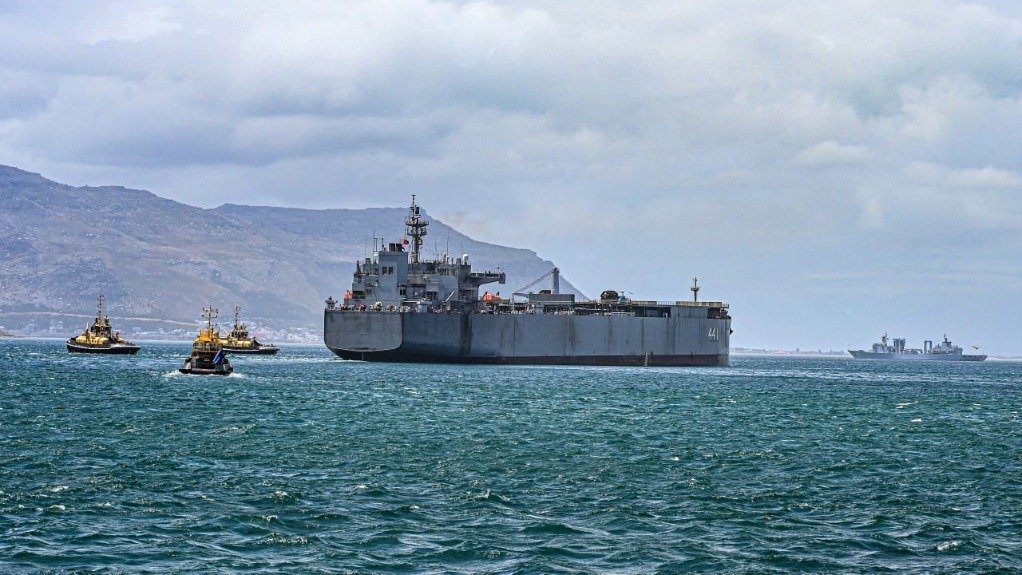
Exercise Will for Peace exposed a disjointed maritime approach that could cost the country dearly.
Exercise Will for Peace, the multinational naval exercise run off South Africa’s Cape Peninsula between 9 and 16 January, was presented as enhancing participants’ maritime security capabilities. It brought together the navies of several of South Africa’s BRICS partners including China, Russia, the United Arab Emirates and Iran.
But rather than improving South Africa’s naval capacity, the exercise has further disrupted the country’s fragile posture of non-alignment and weakened its international standing.
Much of the subsequent damage would have been limited had South Africa been conducting naval diplomacy in line with a coherent maritime strategy. This could have anchored defence activities – including naval exercises – within a holistic foreign policy framework guided by diplomatic and economic considerations.
The mixed messaging around the exercise shows a worrying lack of strategy. Early efforts to frame it as part of BRICS were unconvincing to key BRICS members. While several of them – Egypt, Ethiopia and Indonesia – participated as observers, India and Brazil were absent. India explicitly distanced itself, saying the exercise was ‘entirely a South African initiative’ conducted outside the BRICS framework.
This ambiguity was compounded by inconsistent official statements, including by South African President Cyril Ramaphosa, that Will for Peace reflected a China-led initiative. That information left the exercise’s political rationale unclear and raised questions about why it was considered an appropriate vehicle to pursue its stated objectives. The exercise also drew external criticism from countries such as the United States (US).
Poor US-South Africa bilateral relations made the exercise even more contentious. Pressure from Washington lawmakers to reassess ties with Pretoria has been mounting for years, driven largely by Pretoria’s sustained engagement with Iran, China and Russia.
America took the golden opportunity presented by Exercise Will for Peace to criticise South Africa at a time when the country is economically vulnerable to pressure over the renewal of the African Growth and Opportunity Act.
Including two Iranian naval vessels and a third from the Islamic Revolutionary Guard Corps Navy raised deeper concerns about South Africa’s strategic coherence around defence diplomacy and civil-military command and control. The Iranian vessels’ arrival coincided with the most intense public protests against Iran’s government in recent years.
Reports subsequently indicated that South Africa’s Presidency instructed Defence Minister Angie Motshekga to ensure Iran’s withdrawal. This extraordinary intervention pointed to serious misalignment between political authority and military execution.
The South African National Defence Force (SANDF) did little to clarify or defend its position publicly. Most notably, it ceased communication after a swiftly deleted social media post highlighting Iran’s participation. Despite Ramaphosa’s apparent instruction, onlookers observed an Iranian corvette repeatedly sailing out of Simon’s Town harbour to the exercise area between 13 and 15 January.
The issue now extends far beyond diplomatic embarrassment, exposing deep institutional failure. If a presidential directive was ignored, this suggests either ineffective communication or a severe disconnect between military command and civilian authority. Either way, South Africa seems to lack meaningful control over a major multinational exercise in its own waters.
Without authoritative communication, scrutiny quickly turned to institutional incompetence and governance failure. The apparent disconnect among the Presidency and cabinet, Department of Defence and Military Veterans, Department of International Relations and Cooperation, and SANDF intensified domestic perceptions of broader leadership dysfunction.
Only on Friday 16 January, did the defence department issue a formal statement announcing the establishment of a Board of Inquiry. The inquiry will investigate why the president’s directive was not implemented, and at whose door responsibility ultimately lies.
Most fingers are pointing at Navy Chief Vice Admiral Monde Lobese. But once forces are assigned for an exercise, operational control rests with the Chief of Joint Operations, Lieutenant General Siphiwe Lucky Sangweni.
The absence of a national maritime security strategy and clear command and control is no longer just a policy gap – it has become an operational and political liability. Civilian authority, military planning and diplomatic signalling remain misaligned, with predictable consequences.
According to Lobese, ‘The South African Navy is always ready to cooperate with other navies to achieve the crucial common goal of maritime security.’ To have credibility, this claim must be matched by actions, including resuming long-delayed exercises with a broader range of partners than those participating in Will for Peace.
A coherent strategy would clarify who South Africa should exercise with, how such exercises are authorised, and how political risk is weighed against operational benefit.
Ultimately, non-alignment does not imply disengagement. Rather, it requires deliberate diversification to avoid exclusivity and dependency. In the current context, South Africa’s exercise pattern risks achieving the opposite of non-alignment.
This represents a marked departure from earlier practice. From 1994 until the late 2010s, the South African Navy routinely participated in or hosted various multinational exercises across different political groupings and geographic theatres.
These included India, Brazil, South Africa Maritime (IBSAMAR); ATLASUR with Brazil and Uruguay, with Argentina and Chile participating in earlier cycles; Exercise Oxide with France; and Exercise Good Hope with Germany. These engagements more closely reflected the logic of non-alignment through diversification.
South Africa now awaits the Board of Inquiry’s findings. Although such inquiries signal that government takes an issue seriously, they are a familiar containment mechanism often used to buy political time and avoid taking action against wrongdoing.
The findings may not address the profound disconnect between the country’s defence and foreign-policy establishment – one that appears increasingly ill-suited to a fluid geopolitical environment in which strategic discipline and civilian authority matter more than ever.
Written by Timothy Walker, Senior Researcher, Maritime, ISS Pretoria & Priyal Singh, Senior Researcher, Africa in the World, ISS Pretoria
EMAIL THIS ARTICLE SAVE THIS ARTICLE ARTICLE ENQUIRY FEEDBACK
To subscribe email subscriptions@creamermedia.co.za or click here
To advertise email advertising@creamermedia.co.za or click here

