





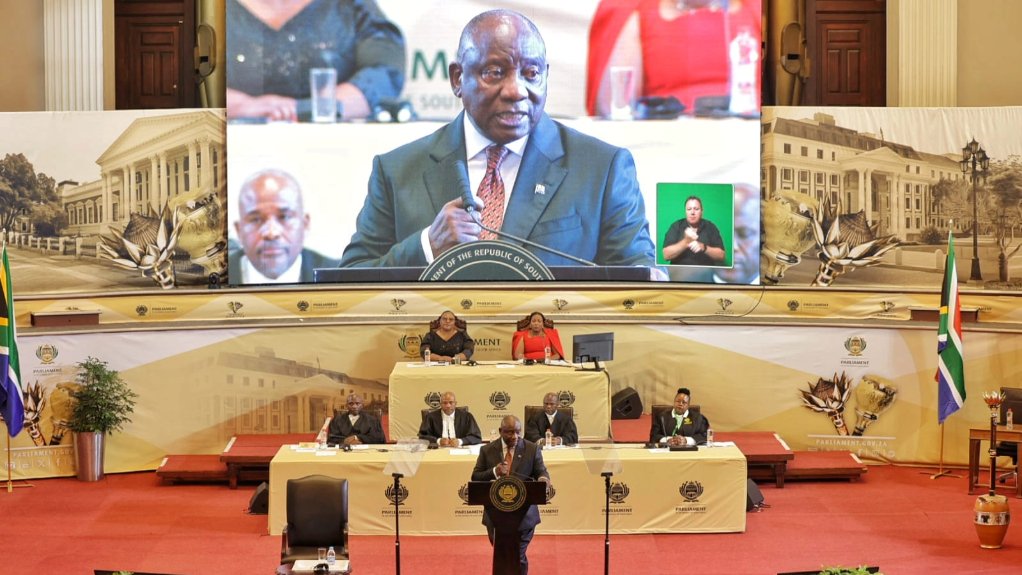
South African president Cyril Ramaphosa is expected to deliver the state of the nation address (Sona) on 12 February 2026.
The annual speech is an opportunity to give an update on government commitments and outline key priorities for the year.
Ahead of the address, we revisited Sona 2025, following up on six promises made. Has Ramaphosa kept his word?
Promise: “Within the next year, we will complete the establishment of the National Water Resource Infrastructure Agency.”
Verdict: In progress
Ramaphosa said that ensuring a secure and reliable supply of water across the country was a priority. He acknowledged that many people faced regular water shortages due to failing water infrastructure, a topic that has stoked public debate.
“Within the next year, we will complete the establishment of the National Water Resource Infrastructure Agency,” or NWRIA, Ramaphosa continued.
The creation of such a national entity has been on the cards for some time. It was listed as a priority in the Department of Water and Sanitation’s (DWS’s) annual performance plan for 2023/24, with various steps set to be taken over the following three years.
The agency is meant to be the single entity responsible for maintaining and developing the country’s water infrastructure. According to the DWS, the agency would triple investment from R10-billion to R30-billion.
To meet Ramaphosa’s commitment, the agency would need to have been established by February 2026. But in March 2025, the DWS said it was aiming to have completed this by mid-2026.
We asked the department what progress had been made so far. In response, it highlighted “preparatory work”, including processing the National Water Infrastructure Agency Amendment Bill through parliament, a requirement to then list the NWRIA as a major public entity. In February 2026, the department said the bill had been passed by the national assembly and would be presented to the national council of provinces “next week”.
Another outstanding step is the appointment of a board for the agency. The department said it expected this to happen before April 2026, after which the NWRIA would become a functional legal entity. It said it was confident this would be done by then.
Promise: “This year, we will launch the electronic travel authorisation system.”
Verdict: Kept
The electronic travel authorisation (ETA) system would “enable a secure, fully digital visa application process” for visitors to South Africa, Ramaphosa said.
In September 2025, the system was launched by home affairs minister Leon Schreiber.
As of February 2026, only citizens of China, Indonesia, India and Mexico were eligible to apply for an ETA, provided they were entering the country via OR Tambo International Airport or Lanseria International Airport in Gauteng province, or Cape Town International Airport.
According to the Department of Home Affairs, once the system is stable, it will be expanded for tourists from all countries that require visas to visit South Africa. The Department of Tourism forecasts that the full rollout of the ETA will create up to 100 000 jobs and boost arrivals in the country, which reached their highest level yet in 2025.
Promise: “We will [soon] adopt the National Strategy to Accelerate Action for Children.”
Verdict: Kept
Ramaphosa said that the National Strategy to Accelerate Action for Children (NSAAC) focused on 10 key priorities, including poverty reduction, child protection and malnutrition.
The strategy was driven by concerns about stalled progress in children’s well-being, among others. It aims to rally government and society to support and protect children so they can build a better future for South Africa.
While Ramaphosa didn’t give a timeline in his live address, the published text version included the word “soon”.
The NSAAC has been in development since October 2024.
Mesuli Kama works for Hold My Hand, a national campaign supporting the NSAAC. He told Africa Check that the strategy’s purpose was to build a common understanding of the national priorities for children and adolescents. Civil society and the private sector also needed to be involved, he said, to support the implementation of priorities that did not “fit neatly into single departmental mandates”.
The cabinet adopted the strategy on 5 December 2025, although Africa Check could not find it online, and the presidency has not responded to requests for a copy.
Kama said that the immediate promotion of the strategy and a commitment to realise its objectives would be ideal, but stressed that the accountability mechanisms needed to be strengthened.
He added that one of the most significant gaps in the implementation of the NSAAC was centralised coordination. He gave the unresolved relocation of the Office on the Rights of the Child from the Department of Social Development to the presidency as an example of a key barrier. Some campaign groups have argued that moving the office would ensure that all departmental ministers remained accountable to the presidency on issues affecting children.
Promise: “To ensure that we reach the target of 95-95-95 … we will this year launch a massive campaign to look for an additional 1.1-million people who are not yet on treatment [for HIV].”
Verdict: Kept
Ramaphosa is referring to the HIV/Aids 95-95-95 targets, a United Nations initiative to end the Aids epidemic as a public health threat by 2030.
HIV, or human immunodeficiency virus, is a virus that attacks the immune system, which protects the body from disease. Untreated HIV eventually causes Aids or acquired immunodeficiency syndrome.
The aims of the 95-95-95 initiative are for 95% of all people with HIV to know their status, for 95% of those people to be on treatment, and for 95% of those on treatment to have achieved viral suppression. HIV cannot be cured, but if taken regularly, anti-retroviral (ARV) medications can reduce the presence of the virus in a person’s blood to the point that it is undetectable and cannot be transmitted to others – this is “viral suppression”.
The sixth South African National HIV Prevalence, Incidence and Behaviour Survey (SABSSM VI), published in 2024, estimated that of the roughly 7.8-million people in South Africa living with HIV, 89.6% (just under 7-million) knew their HIV status. To meet the second 95-95-95 target, just over 6.6-million of these people would need to be on ARV treatment, but SABSSM data put this figure at 5.7-million. This suggests that 1.1-million people knew their HIV status, but were not receiving ARV treatment.
To make up for this shortfall, South Africa launched the Close the Gap campaign in February 2025, shortly after Ramaphosa’s address. So this promise has been kept. But has the campaign achieved its goals?
‘Persistent problem with reaching the second 95% target’
No major updates have been released about the progress of the campaign. Prof Khangelani Zuma, head of biostatistics at the Human Sciences Research Council (which conducts the SABSSM), told Africa Check that the next edition of the survey would not be due for several years.
Evaluating the success of the campaign “will require new data that we don’t have at this stage”, he said.
Thembisa, a frequently-cited mathematical model which tries to predict data about HIV, was last published in May 2025 and noted “a persistent problem with reaching the second 95% target”. The next update from the model, which may give some indication of the success of the Close the Gap campaign, is not expected until March or April 2026.
In May 2025, health minister Aaron Motsoaledi said that 520 700 people living with HIV had been reached by then and that the plan was to reach 1.1-million people by the end of December.
But as health journalism outlet Bhekisisa reported at the time, this did not account for people who might have previously stopped treatment – or even stopped and restarted multiple times – meaning that some of those half a million people might have been counted multiple times. Motsoaledi’s figures, which one expert called “inconceivable”, didn’t prove that half a million new patients had started and stayed on ARV treatment.
At a commemoration ceremony for World Aids Day on 1 December, deputy president Paul Mashatile said the first and third 95-95-95 targets had been surpassed. However, he noted that challenges in initiating and retaining diagnosed individuals on treatment persisted. He gave South Africa’s statistics as 96-80-97.
Promise: “Another 16 sexual offences courts will be established in the next financial year.”
Verdict: In progress
Ramaphosa announced this commitment to much applause. South Africa’s challenges in addressing gender based violence are widely recognised.
Sexual offence cases are complex and difficult to prosecute because they rely on expert evidence, and the offences often happen without witnesses. Court processes can also re-traumatise victims if officials are not properly trained or if the court environment is not suitable.
This is where sexual offences courts (SOCs) come in. They are specialised court systems that aim to provide a victim-centred approach and appropriate physical spaces. South Africa piloted its first SOC in 1993, with good results. By 2005, more than 70 SOCs were operating, leading to more cases finalised, better treatment of victims and higher conviction rates.
But concerns arose that SOCs were better resourced than ordinary courts, potentially undermining equality before the law. As a result, the rollout stopped and existing SOCs were absorbed into the general court system, losing their specialised focus. Conviction rates then fell, and cases took longer to complete, according to a ministerial task team appointed to investigate the issue. The task team reaffirmed the need for SOCs in 2013 and in 2024 a legal amendment created a framework to formally designate SOCs, allowing new courts to be established and older ones to be re-established.
In October 2025, almost 80 sites were designated for SOCs. The Department of Justice and Constitutional Development planned to establish SOCs at 16 of those sites in 2025/26.
The department’s media liaison team told Africa Check that it aimed to establish eight of these courts in the third quarter of the financial year (October to December 2025), and the rest in the fourth (January to March 2026).
Departmental reporting shows these targets are on their way to being met. All eight of the SOCs planned for the third quarter have been established. The department said these met specific requirements in the regulations relating to sexual offences courts and were operational.
The remaining SOCs to meet the 2025/26 target were earmarked to be established between January and March 2026.
Promise: “We will … introduce the Whistleblower Protections Bill in parliament during this financial year.”
Verdict: In progress
A whistleblower is an individual, often an employee, who reports or discloses information about wrongdoing within an organisation and reasonably believes that the information reveals conduct that is illegal, criminal, unethical, corrupt or in violation of the law.
Dr Liezl Groenewald, chief executive of The Ethics Institute and co-founding director of public benefit organisation The Whistleblower House, told Africa Check that whistleblowers play a crucial role in combating corruption and serious crime in South Africa.
“Many major corruption scandals, particularly those involving public procurement, state-owned entities, and organised crime, have come to light primarily because insiders were willing to speak out,” she said.
The introduction of a dedicated whistleblower protections bill was extremely important and long overdue, Groenewald added.
“A dedicated bill would send a strong political and social signal that whistleblowing is a public service rather than an act of disloyalty, helping to shift the prevailing culture of fear and silence.”
During a media briefing in December 2025, justice minister Mmamoloko Kubayi said that the Whistleblower Protections Bill, renamed the Protected Disclosure Bill, had been completed and was undergoing legal evaluation. This process would be finalised in the last quarter of the financial year (January to March 2026), she said, after which the bill would be submitted to cabinet and then introduced in parliament.
Whether this will happen within the timeframe Ramaphosa gave is unclear, so we’ve rated this promise “in progress”.
Deficiencies with the current system
South Africa’s whistleblower protection system is currently primarily based on the Protected Disclosures Act of 2000 (PDA) and the Witness Protection Act of 1998.
The PDA is intended to protect employees who report illegal conduct at work. The Witness Protection Act, on the other hand, focuses on physical protection for threatened witnesses, mainly in criminal cases, and does not specifically address workplace or corruption-related reports.
In practice, these laws have significant limitations. According to Groenewald, current protections for whistleblowers are fragmented across different laws, creating gaps, uncertainty and inconsistent enforcement.
Protection under the PDA applies mainly to employees, at the exclusion of other categories of whistleblowers, and places a heavy burden on individuals to prove they followed the correct reporting procedures. Remedies for retaliation against whistleblowers are limited, and there is no dedicated, independent body responsible for whistleblower protection.
As a result, whistleblowers have repeatedly reported being dismissed or threatened after making disclosures. Some have even been killed.
“These challenges mean that many potential whistleblowers choose silence over disclosure, undermining anti-corruption efforts and weakening democratic accountability,” Groenewald told Africa Check.
Researched by Africa Check
EMAIL THIS ARTICLE SAVE THIS ARTICLE FEEDBACK
To subscribe email subscriptions@creamermedia.co.za or click here
To advertise email advertising@creamermedia.co.za or click here

