





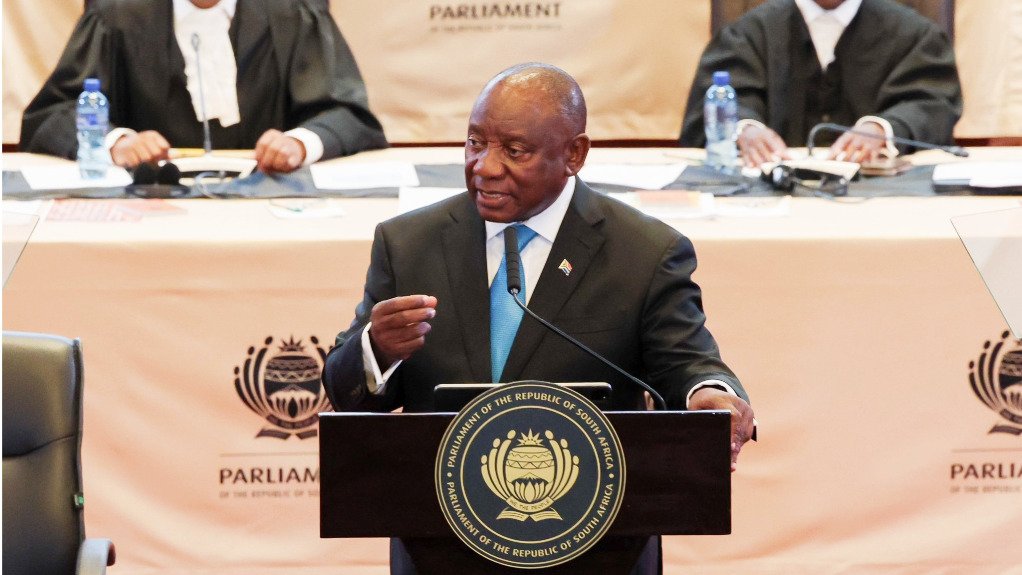
President Cyril Ramaphosa has directly intervened in the dispute over Eskom’s unbundling plan, announcing in his 2026 State of the Nation Address (SoNA) that the independent Transmission System Operator (TSO), being set up outside of the State-owned entity, will own and operate the transmission assets.
The statement directly contradicts the unbundling plan announced by Electricity and Energy Minister Dr Kgosientsho Ramokgopa in December, which stated that, while the TSO would be the system and market operator, the National Transmission Company South Africa (NTCSA) would retain the transmission assets and remain an Eskom Holdings subsidiary.
This unbundling announcement was met with surprise by organised business, and even parts of government, as it was seen as a clear deviation from the economic reform agenda being pursued under Operation Vulindlela.
Ahead of the SoNA, both Business Unity South Africa and Business Leadership South Africa (BLSA) expressed unhappiness with the development, with BLSA having urged the President to use his address to place the key electricity reform back on track.
In his February 12 speech to a joint sitting of Parliament at the Cape Town City Hall, Ramaphosa underlined the importance of creating a level playing field for competition in the electricity supply industry “so that we are never again exposed to the risk of relying on a single supplier to meet our energy needs”.
“We are restructuring Eskom and establishing a fully independent State-owned transmission entity.
“As I have said before, this entity will have ownership and control of transmission assets and be responsible for operating the electricity market.
“Given the importance of this restructuring for the broader reform of the electricity sector, I have established a dedicated task team under the National Energy Crisis Committee (Necom) to address the various issues relating to the restructuring process, including clear time frames for its phase implementation.”
He said the ministers of electricity and energy, finance and in the presidency would now work together to finalise the restructuring proposal, its timelines and an implementation plan.
“This task team will report to me within three months,” Ramaphosa said.
Water Crisis Committee
In a speech laden with infrastructure priorities and held against the backdrop of widespread protests in Gauteng over sustained water outages, the President also announced the creation of a new crisis committee for water, which he would chair.
The structure would follow a similar approach to that of Necom, which was set up at the height of the country’s loadshedding crisis, and which had since been stabilised.
The National Water Crisis Committee would bring together various existing efforts into a single coordinating body, including the effort being undertaken by Deputy President Paul Mashatile to work with various water authorities.
“It will deploy technical experts and resources from national government to municipalities facing water challenges; it will ensure that action is taken swiftly and effectively to address the problem, to address the challenges effectively,” he said.
Ramaphosa also said that the powers enshrined in the Constitution and the Water Services Act would be deployed, where necessary, to intervene directly in underperforming municipalities.
“We will hold to account those who neglect their responsibility to supply water to our people. Government has already laid criminal charges against 56 municipalities that have failed to meet their obligations. We will now move to even lay charges against municipal managers for violating the National Water Act.”
EMAIL THIS ARTICLE SAVE THIS ARTICLE ARTICLE ENQUIRY FEEDBACK
To subscribe email subscriptions@creamermedia.co.za or click here
To advertise email advertising@creamermedia.co.za or click here

