





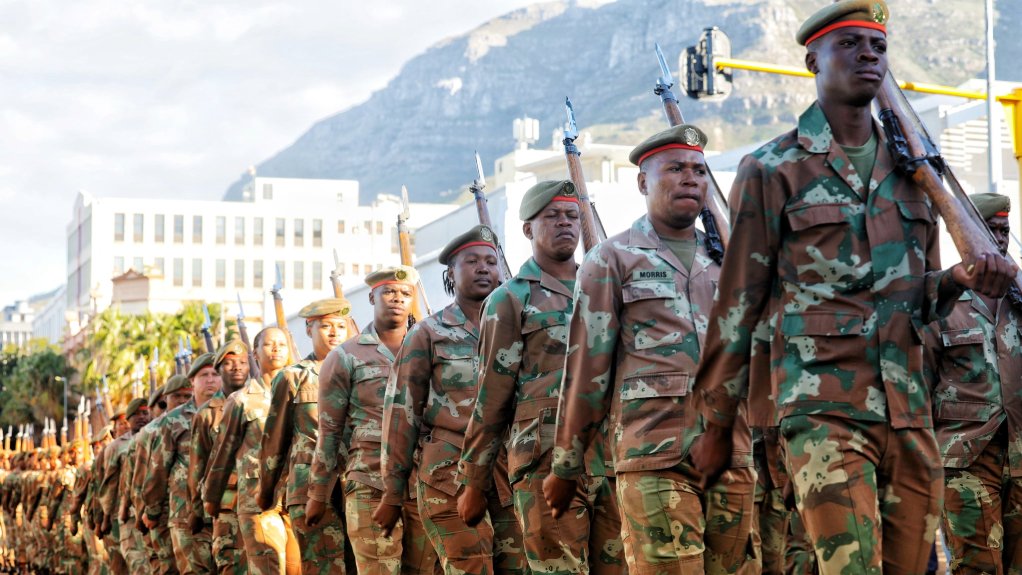
Government is working to close funding gaps and strengthen the readiness of the country’s armed forces to assist the South Africa National Police Service (Saps) in fighting organised crime, according to President Cyril Ramaphosa.
On Monday, in his weekly letter to the nation, Ramaphosa defended his decision to deploy the South African National Defence Force (SANDF), to support the Saps in tackling gang violence and illegal mining in the Western Cape, Gauteng and Eastern Cape.
Ramaphosa wrote that given the country’s history, where the apartheid State sent the army into townships to violently suppress opposition, it is important that the SANDF is not deployed inside the country to deal with domestic threats without good reason.
He argued that the recent deployment is necessary owing to a surge in violent organised crime.
Ramaphosa received criticism for this move, with some opposition parties claiming this is government’s admission that it has failed to strengthen the Saps.
Ramaphosa assured that the SANDF will be deployed in support of the Saps, operating under police command, with clear rules of engagement and for specific time-limited objectives.
“The SANDF may, for example, be called on by the police to provide protection in high-risk operations, or to support cordon-and-search operations against armed criminals. Soldiers may also help to secure critical infrastructure, freeing Saps members to focus on investigations, arrests and building cases that lead to successful prosecutions,” he explained.
He pointed out that the deployment of the SANDF will take place alongside other measures, such as strengthening anti-gang units and illegal mining tasks teams.
Police will also collaborate with the National Prosecuting Authority on multi-disciplinary task teams to target the leadership, finances, firearms and logistics of criminal networks.
On Saturday Ramaphosa officiated the Armed Forces Day commemoration in Limpopo.
He said in an era defined by increased geopolitical tensions, the country’s armed forces safeguard sovereignty and promote peace and stability beyond the country’s borders.
“They also have an important role inside the country,” he added.
He highlighted that this is not the first time that the SANDF has been deployed domestically, noting disaster response and development support.
He said during the recent floods in parts of Limpopo and Mpumalanga, the SANDF supported relief efforts and assisted with evacuations, repairing damaged infrastructure and erecting temporary structures.
“Through Project Owethu, which was launched in Limpopo to coincide with Armed Forces Day, the SANDF provided healthcare services to more than 50 000 people in underserved communities,” he explained.
He pointed to the unprecedented mobilisation of the SANDF during the Covid-19 pandemic, which he said enabled government to enforce disaster regulations, safeguard the borders, support anti-crime efforts with the Saps and set up field hospitals to tend to the sick.
Meanwhile, he said government is also strengthening the complement of younger people in the SANDF.
He explained that applications recently opened for the 2027 Military Skills Development System, which offers young people the opportunity to gain skills and training in the army, air force, navy and military health service.
EMAIL THIS ARTICLE SAVE THIS ARTICLE ARTICLE ENQUIRY FEEDBACK
To subscribe email subscriptions@creamermedia.co.za or click here
To advertise email advertising@creamermedia.co.za or click here

