





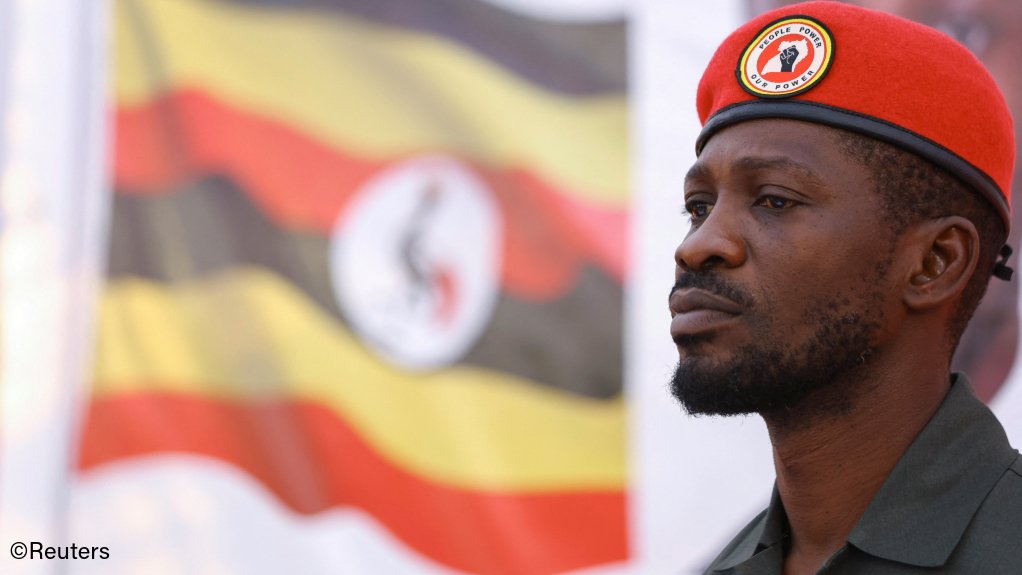
Uganda’s main opposition leader called for a freeze on foreign funding for President Yoweri Museveni’s administration, saying international support is sustaining repression as the country approaches elections marked by security crackdowns and internet restrictions.
“We’re not asking the West or the international community to come and save us, but we’re asking them not to sponsor our oppression,” Bobi Wine, a pop star–turned–politician whose real name is Robert Kyagulanyi, said in an interview with Bloomberg on Wednesday. “If you are not giving money to dictators in Europe, why do you fund the dictators in Africa?”
Museveni, 81, who took power in a coup in 1986 — when Wine was four years old — and has been accused by civil rights groups of increasing authoritarianism and quashing any opposition, is standing for a seventh term in next week’s vote. Wine said he has been wearing body armour while campaigning because his life is in danger.
“I was supposed to be killed by the bullet that got my driver,” he said, referring to an incident during the previous elections in 2021, when he made his first run at the presidency and his vehicle came under fire. “I campaign with the flak jacket and ballistic helmet on — not for smartness but for safety.”
Wine has been persistently harassed by the authorities, and has survived other attempts on his life, including in 2024 when he suffered shrapnel injuries during clashes with security forces. Six years earlier, he sought medical attention in the US after sustaining serious injuries while in military custody.
Kizza Besigye, another opposition politician who unsuccessfully ran against the incumbent four times, has been in detention for more than a year and is facing treason charges.
Wine said about 550 members of his party, the National Unity Platform, have been incarcerated. He warned that abductions by the security forces have resumed and they were plotting to intimidate voters.
His concerns about the integrity of the election have been echoed by rights group Amnesty International. It has accused the Ugandan security forces of unlawfully targeting opposition rallies with unnecessary and excessive force and arbitrary arrests in the lead-up to the election, and subjecting some attendees to torture or other ill-treatment.
“The so-called NUP supporters are inciting violence, they are encouraging their people to be lawless, and we cannot just sit and watch,” said Chris Magezi, acting army spokesperson. “The law and security agencies are doing their work.”
Jervin Naidoo, a political analyst at Oxford Economics, said Wine would likely secure a “narrow win” — if the vote was free and fair.
“Our baseline scenario continues to point to a Museveni victory amid a flawed electoral process,” with Wine finishing a close second, Naidoo said in a note. “However, given recent flawed elections in Tanzania and widening protest movements across the continent, driven by frustration with poor governance, we think some international pressure on Uganda may force authorities to hold a ‘freer’ election.”
The Electoral Commission has been acting in line with the law and isn’t favouring any political side, according to spokesman Julius Mucunguzi.
Wine said he expects an internet shutdown, as in past elections, and criticised Starlink for complying with a government directive issued earlier this year to restrict its service in Uganda. Although Starlink isn’t licensed in the country, some users purchased kits and were accessing signals from neighbouring states.
Starlink has applied for authorisation to operate in Uganda, but has yet to meet pre-licensing regulatory requirements, the Uganda Communications Commission said in a statement.
Wine said the company’s actions conflicted with its stated opposition to authoritarianism.
“I saw the CEO of Starlink, Elon Musk, praising America about what they did in Venezuela and that dictators must not be supported in any way,” he said, referring to the US capture of Venezuelan President Nicolas Maduro. Yet by enforcing geolocation controls, Starlink is enabling a dictator, who has survived by blacking out information from his people, he said.
The least Starlink “can do to help save our democracy is to allow people to communicate,” he added. “Democracy dies in the dark.”
Starlink owner SpaceX didn’t immediately respond to an emailed request for comment.
EMAIL THIS ARTICLE SAVE THIS ARTICLE FEEDBACK
To subscribe email subscriptions@creamermedia.co.za or click here
To advertise email advertising@creamermedia.co.za or click here

