





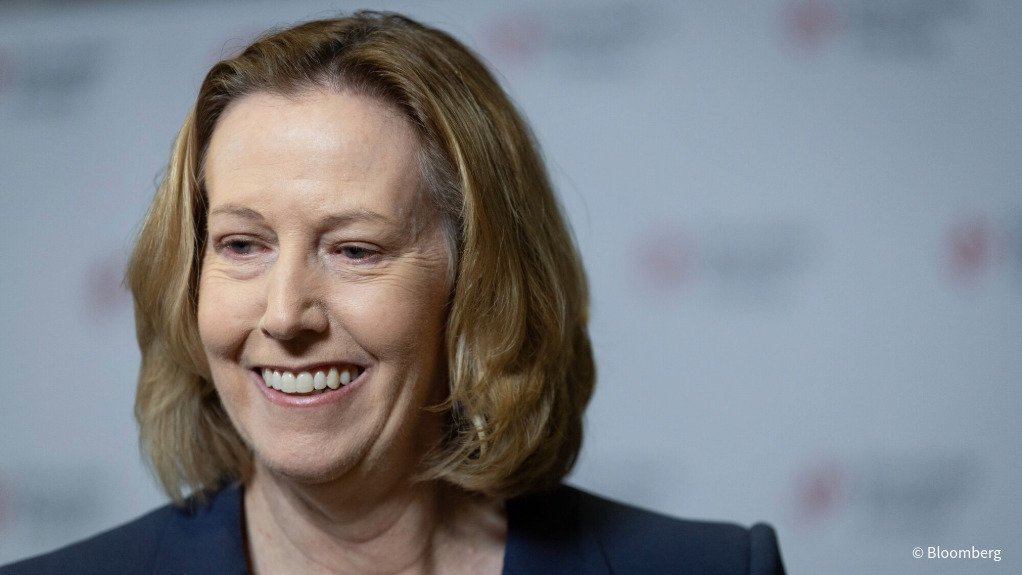
Meg O’Neill’s rapid rise to the top of one of the world’s biggest fossil-fuel companies has been unencumbered by doubt. At a moment when oil executives are still being pressed to move away from hydrocarbons, she has a different argument: that the world is nowhere near done with them.
So when BP stunned markets by naming an external chief executive officer for the first time, the choice of O’Neill signaled more than a leadership change. It marked a recalibration for BP, bruised by a failed pivot toward renewable energy, years of uneven financial performance, and pressure from activist investor Elliott Investment Management to return the company to its core oil and gas focus.
O’Neill, who has led Australian oil and gas giant Woodside Energy Group since 2021, arrives with a reputation for operational rigor and a belief that natural gas, particularly liquefied natural gas, is a long-term necessity. To supporters, she is exactly the leader BP needs. To critics, she represents an industry choosing regression over reinvention.
“Her appointment as CEO seems well-aligned with BP’s reversal from green energy back to core oil and gas profitability,” said Susan Sakmar, a University of Houston Law Center visiting assistant professor and expert on the oil and gas market. “Good news for BP.”
She takes on her new role amid a wider political split over energy. US President Donald Trump’s revived “drill, baby, drill” mantra and promises to roll back years of climate rules that, he argues, drove up energy costs have led to a renewed emphasis on oil and gas. And while Asian consumers are hungry for more fossil fuels, BP in Europe faces a different reality of tougher carbon-reduction mandates, stricter disclosure rules and regulatory pressures to show progress toward cutting emissions.
O’Neill will have to navigate both worlds at once.
Inside Woodside, current and former colleagues describe O’Neill as analytically rigorous and intensely prepared. Self-described as outspoken, she pushes teams to think decades ahead rather than fixate on near-term volatility, according to people familiar with her management style who asked not to be identified.
O’Neill has argued that pragmatism, not ambition alone, should determine which climate solutions survive. Under her watch, Woodside doubled oil and gas output, leaned aggressively into seaborne LNG, and shelved lower-carbon projects that failed to clear commercial hurdles. “We should prioritise measures that deliver the biggest bang for buck,” she told a room of mining executives at the Melbourne Mining Club in February.
The following month, in an interview with Bloomberg TV, O’Neill remained undeterred. “Many nations have aspirations to grow renewables,” she said. “They’re going to need more gas to partner with those renewables.” Woodside expects LNG demand to grow 50% over the next decade, she added.
Her strategic move of transforming Woodside from a regional producer into a diversified global LNG player will serve her well at BP, said analysts at Piper Sandler. But it has also made her a lightning rod for criticism, with mounting complaints from environmentalists in Australia. Much of the critique centers on the Burrup Hub – a multibillion-dollar suite of projects championed by O’Neill. That includes a decades-long extension to the North West Shelf project, where emissions through 2070 (including gas burned overseas) have been estimated at roughly ten times Australia’s current annual total.
At times, the backlash turned personal. In 2023, activists from the Disrupt Burrup Hub campaign were stopped by counter-terrorism police outside her Perth home, with a yellow spray can and some water balloons found nearby.
“She steered Woodside and its lobbyists to help undermine actions and policies critical to aligning our country with climate science,” said Tim Buckley, director of Australian advisory firm Climate Energy Finance. “Meg O’Neill will in all likelihood accelerate BP’s retreat from zero emissions energy solutions and double down on LNG.”
O’Neill has explored alternatives, backing carbon-management initiatives and green hydrogen projects in New Zealand, Tasmania and Australia. But when costs rose and economics deteriorated, she pulled back. She has argued that gas typically produces around half the life cycle emissions of coal when used to generate electricity, and therefore provides a vital lifeline for a stable grid during the energy transition. Environmentalists say that doesn’t properly account for the release of methane or CO2 emissions during LNG production.
Those in the energy industry have criticized her too, mainly over Woodside’s financial performance with O’Neill at the helm. Her desire for growth has seen Woodside invest in expensive oil and gas projects in the US and Gulf of Mexico.
“While BP has chronically underperformed the sector, Woodside has chronically underperformed BP,” said Brynn O’Brien, executive director of the Australasian Centre for Corporate Responsibility. “O’Neill is a curious choice in that context. Under her leadership, Woodside has pursued high-cost, marginal fossil-fuel projects without delivering strong shareholder returns.”
Though O’Neill led Woodside during a period of record profits after Russia’s invasion of Ukraine sent gas prices surging, the company’s profits are expected to fall this year. Analysts surveyed by Bloomberg estimate net income dropping 36% to $2.3 billion. Both Woodside and BP’s gross dividend repayments have lagged the World Energy Sector Index over the past five years.
Born in Boulder, Colorado, O’Neill graduated from the Massachusetts Institute of Technology with a degree in ocean and chemical engineering and joined Exxon Mobil in 1994. Early assignments included modeling offshore fields in the US before she was sent to Jakarta in the early 2000s to manage LNG operations. She later led Exxon’s businesses in Canada and Norway and oversaw Asia-Pacific operations during the region’s LNG boom.
In 2016, she became executive adviser to Exxon’s chairman and chief executive, Rex Tillerson before his nomination as US Secretary of State during Trump’s first term. There, she got a front-row seat in managing an oil giant, and learned how words echo through a sprawling organization. “Anything I say risks causing a ripple,” she told Forbes in 2024. “Rex was masterful at being disciplined with the things he said.”
But beyond the close-knit world of energy, she was relatively unknown until Woodside recruited her in 2018 as chief operating officer. She was then elevated to chief executive in 2021 after then-CEO Peter Coleman retired. She became one of the few women, and openly gay leaders, to take the reins at a major energy company.
O’Neill ended a period of restraint on capital spending at Woodside, approving a $12-billion investment in the Scarborough and Pluto Train 2 LNG developments and completing the company’s multibillion-dollar acquisition of BHP Group’s petroleum business. She later pushed the company deeper into the US, acquiring a long-delayed LNG export terminal in Louisiana in 2024 and approving a $17.5 billion build-out the following year. Woodside said the project could position it to supply more than 5% of global LNG demand in the 2030s.
For O’Neill, BP offers a larger platform and a harder test. Global oversupply threatens to weigh on oil and gas earnings for years, even as shareholders press BP to improve returns. She will be closely watched by BP’s chairman, Albert Manifold, appointed in July, as well as by activist investors such as Elliott, which has demanded changes including substantial cost cuts, asset sales and an exit from renewables.
“It is going to be a huge job,” said Neil Beveridge, managing director of research at Bernstein.
©2024 Bloomberg L.P. All Rights Reserved
EMAIL THIS ARTICLE SAVE THIS ARTICLE FEEDBACK
To subscribe email subscriptions@creamermedia.co.za or click here
To advertise email advertising@creamermedia.co.za or click here

