





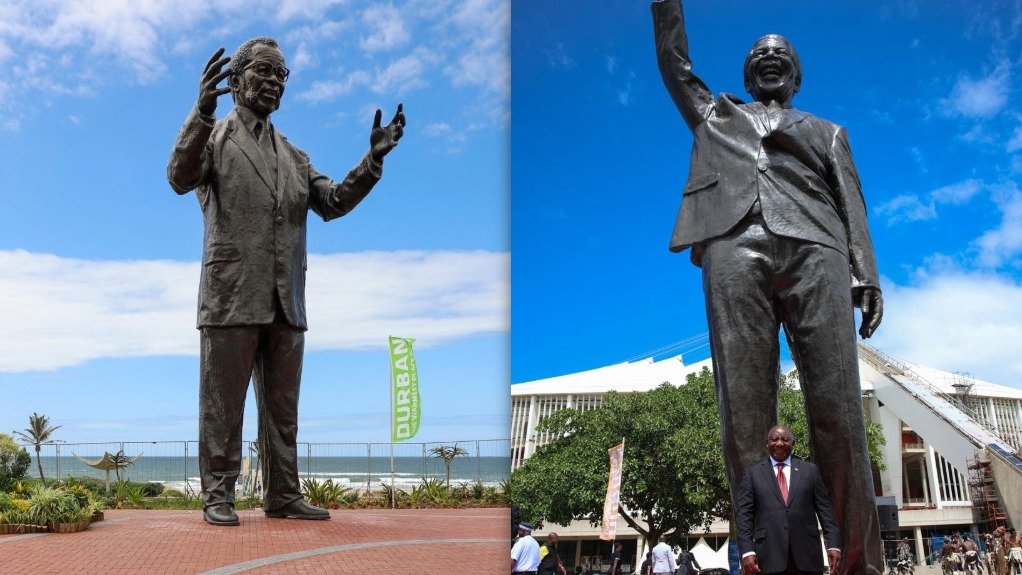
President Cyril Ramaphosa said in erecting former President Nelson Mandela and former African National Congress (ANC) President Oliver Reginald Tambo’s statues, government is affirming the importance of preserving the country’s heritage for the benefit of future generations.
Speaking during the unveiling of the statues in KwaZulu-Natal, Ramaphosa announced that eThekwini would be the venue for the forty-sixth Ordinary Summit of Heads of State and government of the Southern African Development Community (SADC) to be held in August.
He explained that having Mandela’s and Tambo’s statues in the same city honours their “distinct but interlocking contributions and roles in the liberation struggle”.
Ramaphosa said the statues were a “worthy recognition” of the progress made by all social partners in restoring confidence in Durban as a city, and encouraged completion of this work.
“We look forward, as the chair of SADC, to invite leaders from across the region to gather here in eThekwini – where the African Union was launched – to deliberate on issues that are critical to the growth and development of Southern Africa,” he stated.
He said it would be a fitting tribute to Mandela and Tambo’s legacies.
“Monuments of this nature are important for preserving our history and heritage. They anchor the collective memory of a nation. They are important as a public affirmation of the values which these leaders represented and the principles for which they fought,” Ramaphosa expressed.
He argued that statues such as these provoked questions and initiated conversations not only about their value but also about the country’s past.
“…the presence of Mandela and Tambo in bronze ensures that their stories and, indeed, the story of our country remains embedded in the landscape of daily life, not confined to textbooks,” he said.
The statues have been unveiled in the year that South Africa celebrate 30 years of the adoption of its democratic Constitution.
Ramaphosa reminisced that it was Tambo who initiated the drafting of the ANC’s Constitutional Principles, which were developed while liberation movements were still banned and while apartheid oppression was at its height.
And 10 years later, Mandela signed South Africa’s democratic Constitution into law.
Ramaphosa said these statues were more than just art.
“These statues are promises – promises made by a free people to themselves that they will not forget what it cost to be free.
“The erection of the statues is an act of national gratitude, of saying to those who gave everything, and to the Mandela and Tambo families, that we do remember the sacrifices that they made by both these leaders and their families,” Ramaphosa added.
MIDDLE EAST CONFLICT
Ramaphosa noted that the relationship between Mandela and Tambo was founded in a desire for justice, saying they sought to solve conflict through dialogue.
“These men of peace would have been gravely concerned by the conflict underway in the Middle East. They would have called for the United Nations Charter to be respected and upheld. They would have joined us in calling for an immediate ceasefire and for the conflict to be resolved through meaningful and earnest negotiations,” he said.
The Middle East is experiencing a massive regional escalation in conflict, following a joint US and Israeli military campaign against Iran, in which Iranian supreme leader Ayatollah Ali Khamenei was killed.
EMAIL THIS ARTICLE SAVE THIS ARTICLE ARTICLE ENQUIRY FEEDBACK
To subscribe email subscriptions@creamermedia.co.za or click here
To advertise email advertising@creamermedia.co.za or click here

