





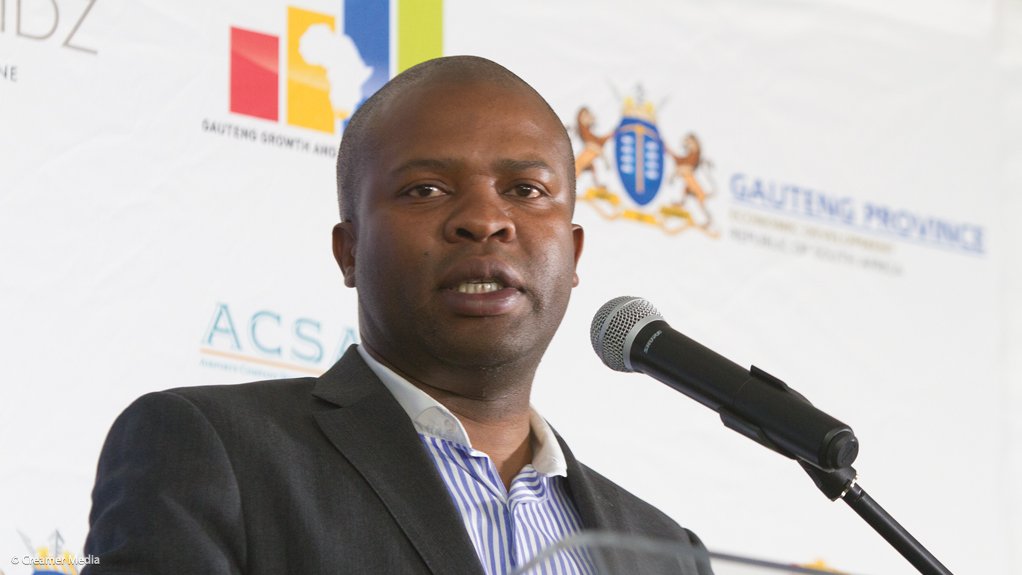
The Gauteng Provincial Government on Tuesday tabled a R179.2-billion budget for the 2026/27 financial year – an increase of R3.6-billion or 2% year-on-year – targeted at addressing frontline services and responding to the Gauteng Medium Term Development Plan (MTDP) 2024 to 2029 provincial priorities.
Of the province’s overall 2026 Medium Term Expenditure Framework (MTEF) budget of R549.3-billion – an increase of 5.2% – R182.4-billion and R188.2-billion, respectively, have been allocated to the 2027/28 and 2028/29 financial years.
While Gauteng remains the economic nerve centre of the national economy, it does not have limitless resources, and the 2026/27 budget tabled will fund “what is prioritised, affordable and deliverable”, said Gauteng Finance and Economic Development MEC Lebogang Maile.
He pointed to a need for pragmatism by ensuring that financial commitments are sustainable rather than merely aspirational, with the immediate task of the Gauteng Provincial Treasury to ensure the priorities are converted from intentions into funded programmes, clear responsibilities and measurable results.
“We too are constrained by the realities of the global and national economic environment. For this reason, we recognise that we cannot resource everything. We must be intentional in funding what works.”
The 2026/27 budget continues to support three priorities outlined in the Gauteng MTDP 2024 to 2029, namely driving inclusive growth and jobs as a means of rebuilding confidence, crowding in investment and unlocking opportunities for work; improving living conditions and wellbeing through reliable services, safety and functioning social services; and building a capable and ethical development State through ensuring clean administration, discipline and consequence management.
With infrastructure investment the base for long-term growth, improved service delivery and job creation, and in line with government’s shift in spending toward growth-enhancing infrastructure, R36.4-billion has been allocated for the infrastructure programme in the 2026 MTEF.
The provincial health, education, human settlements and roads and transport and education departments received an allocation of R34.4-billion, while the sports, arts, culture and recreation, infrastructure development and economic development social development, agriculture and environment departments received total funding of R2.1-billion.
The social sector – health, education and social development – collectively account for an average of 83% of the total budget over the MTEF.
“It is for this reason that we are determined to anchor discipline in how we manage the resources of the province, the bulk of which is allocated to services that our people engage with daily,” said Maile.
The Gauteng Provincial Government allocated R70.9-billion in the 2026/27 financial year, and R221.8-billion over the MTEF, to the Gauteng Department of Education to improve the Early Childhood Development Strategy; improve learner performance programmes, such as the Secondary School Improvement Programme; strengthen school safety initiatives; promote pro-poor interventions, including nutrition and scholar transport; and enhance Schools of Specialisation and inclusive education through special schools.
To strengthen the public health system, expand access and improve the quality of care, the Gauteng Department of Health received R70.3-billion in 2026/27, an amount that will increase to R218.6-billion over the MTEF.
The funding will support maternal and child health, the Ideal Clinic and Ideal Hospital programmes and improved emergency medical response times, as well as the integration of mental health services at community level, digital health systems and electronic records and stronger HIV and TB interventions.
Further unpacking the MTEF, Maile said R1.6-billion would go to the Gauteng Office of the Premier in 2026/27, with a total of R4.7-billion allocated over the MTEF.
This will be used to drive the implementation of the MTDP 2024 to 2029, with focus on tackling crime, growing the economy and investing in education and skills development.
The allocation also makes provision for provincial forensic audits, integrity-building programmes, the Gauteng City Region Academy, the Gauteng AIDS Council and the filling of posts that are ready for appointment.
The Gauteng Provincial Legislature received R1.4-billion in 2026/27, which will increase to R3.3-billion over the MTEF, to strengthen democracy and reinforce accountability by supporting law-making, oversight and public participation.
This includes funding for political parties and constituency support, as well as resources for voter education, information and communications technology (ICT) requirements, committee work, critical vacancies and capital assets, including projects financed through retained income.
Turning to the Gauteng Department of Economic Development, Maile commented that R1.8-billion has been set aside for the 2026/27 financial year, rising to R4.9-billion over the MTEF, to drive inclusive growth and create jobs through economic development and investment promotion.
“This allocation supports the work of the Gauteng Growth and Development Agency and Gauteng Enterprise Propeller, with a strong focus on special economic zones (SEZ) development, township automotive hubs, revitalisation of industrial parks, the Vaal SEZ, bulk infrastructure for Phase Two of Tshwane Automotive SEZ and trade facilitation under the African Continental Free Trade Area,” he said.
A total of R680.5-million was allocated to the Gauteng Department of Cooperative Governance and Traditional Affairs in 2026/27 – rising to R1.9-billion over the MTEF – to strengthen integrated planning, municipal support and coordination from the centre of government.
This includes funding for disaster management capacity, community development workers, the e-indigent register, municipal metering interventions, Integrated Development Plan coordination aligned to the spatial development framework and Expanded Public Works Programme (EPWP) support for employment creation initiatives and stabilising energy supply.
About R5.5-billion was allocated to the Gauteng Department of Human Settlements in 2026/27, rising to R16.6-billion over the MTEF, to expand access to inclusive human settlement opportunities and improve living conditions.
Key priorities include upgrading informal settlements, providing interim sanitation, delivering mega-housing projects and Breaking New Ground units, including serviced stands, accelerating land release, issuing title deeds, strengthening tenure security, maintaining assets, creating EPWP jobs and redeveloping hostels to provide dignified accommodation.
The Gauteng Provincial Treasury will receive R788.4-million in 2026/27 and R2.5-billion over the MTEF to support infrastructure planning and delivery capacity, the deployment of municipal finance experts to strengthen municipal financial management and supply chain management reforms.
The Gauteng Department of Infrastructure Development is allocated a total of R3.7-billion in 2026/27 financial year, with a cumulative total of R10.9-billion over the MTEF, to accelerate social infrastructure delivery, precinct development and job creation. The funding will support provincial infrastructure delivery and maintenance, central business district and precinct revitalisation, office consolidation, EPWP and National Youth Service work opportunities, infrastructure support for catalytic projects including bulk infrastructure, and the devolution of property rates to municipalities to keep schools, health facilities, and social development centres operational, alongside strategic lease management.
Maile said that to build an integrated, safe and affordable transport system, the Gauteng Provincial Government allocated R10.2-billion in 2026/27 and R27.8-billion over the MTEF to the Gauteng Department of Roads and Transport.
This will be used to improve transport infrastructure, strategic road upgrades and rehabilitation linked to SEZ access, as well as the provincial road maintenance programme, EPWP job creation, public transport integration through a single e-ticket system and intermodal hubs and bus service subsidies across the province.
The Gauteng Department of Community Safety received a total of R2.3-billion in 2026/27, rising to R7-billion over the MTEF, to protect communities and strengthen policing oversight, school safety, road safety and the fight against gender-based violence and femicide.
“To expand ICT connectivity and modernise service delivery, we are allocating R1.9-billion in 2026/27 and R5.2-billion over the MTEF to the Gauteng Department of e-Government,” Maile noted, adding that this will support the Gauteng Provincial Network, the expansion of township WiFi hotspots, the installation of CCTV to improve safety in township communities and a one-off injection for goods and services in 2026/27 to strengthen rollout and delivery capacity.
The Gauteng Department of Agriculture and Rural Development was allocated R742.6-million in 2026/27, increasing to R2.2-billion over the MTEF, to strengthen food security and build competitive agricultural value chains.
This will supports subsistence food production, the development and commercialisation of smallholder farmers, agroprocessing and value chain integration and economic growth through stronger biosecurity, export promotion and veterinary services. It also includes targeted R63.9-million funding to contain Foot and Mouth Disease through vaccination and surveillance.
The Gauteng Provincial Government provided R646.6-million in 2026/27, increasing to R2-billion over the MTEF, to the Gauteng Department of Environment to support upgrades to air-quality monitoring, feasibility work for an integrated waste management facility, recycling infrastructure and buy-back centre upgrades, waste minimisation regulations, the Cleaning and Greening Plan, climate change action and awareness programmes and targeted biodiversity protection and maintenance.
Meanwhile, the Gauteng Department of Social Development received R5.6-billion in 2026/27, and R17.2-billion over the MTEF, to support skills development for vulnerable groups, the provincial homelessness strategy, food security interventions, Bana Pele, child and youth care centres, community prevention services, substance use disorder treatment, aftercare services and upgrades to State-owned facilities.
The Gauteng Department of Sport, Arts, Culture and Recreation was allocated R1-billion in 2026/27 and R3.2-billion over the MTEF to support school sport and school arts programmes, community-led social cohesion initiatives and dialogues, the Premier’s performing arts programme and assistance to municipalities for library services.
“The composition of our budget reflects the national reality that provinces fund front-line services, which are largely driven by national transfers. We must be honest about our fiscal reality and the nature of obligations that significantly narrow our room to manoeuvre,” Maile concluded.
EMAIL THIS ARTICLE SAVE THIS ARTICLE ARTICLE ENQUIRY FEEDBACK
To subscribe email subscriptions@creamermedia.co.za or click here
To advertise email advertising@creamermedia.co.za or click here

