





South Africa cannot take the same path to resolve its water challenges as it did with the energy sector during the period of loadshedding, as the structure of the water sector is fundamentally different and requires an “all hands on deck” approach to reverse the deterioration seen over the past few decades.
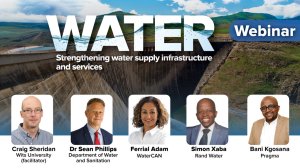
This is one of several key messages that emerged from a high-level discussion hosted by Creamer Media Webinars and facilitated by Professor Craig Sheridan, the director and founder of the University of the Witwatersrand's Wits:H₂O, formerly the Centre in Water Research and Development, on Wednesday.
The webinar, titled ‘Strengthening water supply infrastructure and services’ unpacked wide-ranging critical topics from municipal constraints, funding, procurement, aging infrastructure, corruption, the extensive physical water losses, water mix diversification and the changing legislative landscape, through to the roles played by the Department of Water and Sanitation (DWS), the private sector, municipalities and civil society.
The panel comprised key stakeholders including DWS director-general Dr Sean Phillips; WaterCAN executive manager Dr Ferrial Adam; Pragma chief revenue officer Bani Kgosana; and Rand Water operations GM Simon Xaba.
Adam pointed to the need to be creative in finding solutions for the water and sanitation challenges in South Africa, noting that with more than 70% of water service providers or municipalities not coping with the provision of basic water and sanitation services, there was no quick fix.
In trying to find the solutions for challenges that had spanned 30 years, the same type of thinking and structures that led to the deterioration in the first place could not be used to reverse the damage, she warned.
“[The water sector] is not the same as energy. It is not the same as when we had loadshedding. It is a different sector, with water systems that are very different, and so we need to realise that when we are dealing with water, we cannot have the same mindset that we had with power.”
“We need to think about how we change our systems. Just including business will not actually find solutions.”
Further, the water sector should not move to the point where municipalities are cut out of the equation, despite viewpoints that it is fait accompli that government “messed up”, and that the water sector should be handed over to the private sector to deal with.
“That does not mean that it is going to be fixed. We need municipalities. There is a point to them, and they have an important role to play.”
Phillips added that with municipal water distribution being one of the biggest challenges in South Africa’s water sector, many were questioning why national government did not just intervene in municipalities.
“In reality, South Africa’s Constitution does not allow national government to [interfere with municipal operations],” he said, explaining that there were three spheres of government, and local government was a separate sphere with its own elected representatives.
It is a fundamental part of the challenge faced, and despite expectations for national government to step in, it does not have the legal power to provide orders to municipalities.
“It is not a viable solution. The Constitution puts water services in the hands of municipalities, not the current government,” Phillips continued.
Changing the Constitution has far-reaching implications that would require a two-thirds majority in Parliament and an extensive societal debate.
Further, he noted that many questions would need to be unpacked.
“For example, if water services are taken away from municipalities, will there be a reduction in local democracy and the role of local communities in oversight over local services?”
Amid this, while public-private partnerships (PPPs) may look increasingly attractive as a solution to municipal capacity constraints, caution needs to prevail, and full transparency will be required.
“It is not the new gold rush,” Adam commented, warning that commoditising water and privatisation was not the solution in a country with high inequality.
She cited an example in the UK, where the private sector was leveraged, yet citizens cannot drink water from the tap and the canals are all polluted.
The private sector has a significant and critical role to play, as long as the correct safeguards, including against corruption and procurement abuse, are in place to ensure an improved service alongside the right of access to clean, safe drinking water and sanitation, she said.
“Any partnerships must be very carefully designed. Let us be honest, the PPP model we have in South Africa has also been open to a lot of corruption. We just need to think of the Covid-19 pandemic, where many PPPs were not above board.”
“There has to be transparency, but not half measures of transparency, real transparency - and better controls. There needs to be enforcement on both sides.”
There needs to be strong civil society and independent oversight.
“That means that we must not have opaque arrangements that just shift responsibility from government to the private sector.”
Adam further assured that civil society was not only there when things go wrong, it could also be part of the solution, with communities part of the decision-making.
“We have to work together to fix it. If we just open up, if we are more transparent, if there is better accountability, then it becomes a shared responsibility.”
Phillips urged people to hold their municipalities to account.
“Inevitably, the power to get municipalities to change lies with the electorate who vote for municipal leaders, and that needs to be more recognised. Part of the solution to the problem is in people's hands, because it is the people’s municipalities. It is not the national government's municipalities. They need to take ownership of the municipalities and work with their municipalities to solve the issues.”
The DWS is also working on legislative changes to help guide the water sector back to efficiency and further support municipalities.
It is expected that South Africa’s water sector will be strengthened by the imminent amendments to the Water Services Act (WSA), for example.
The DWS is in the process of amending the WSA to clarify the functions of water services authorities and water service providers; introduce an operating licence for water service providers; and guide the sector towards a utilities model to ensure the ring-fencing of water revenue.
EMAIL THIS ARTICLE SAVE THIS ARTICLE ARTICLE ENQUIRY FEEDBACK
To subscribe email subscriptions@creamermedia.co.za or click here
To advertise email advertising@creamermedia.co.za or click here

