





Amid growing dissatisfaction with the performance of many of the country’s 257 municipalities, 162 of which are categorised as being in financial distress, the National Treasury has outlined what it describes as a fundamental shift in the subnational fiscal architecture that moves from oversight to active structural intervention.
“At the municipal level, this shift involves changes to legislation, governance arrangements and technological intervention,” the Budget Review states, indicating that the proposed municipal reforms are rooted in the revised White Paper on Local Government.
It also states that national government will use powers granted to it under the Constitution to stabilise the system, with unauthorised, irregular, fruitless and wasteful expenditure in municipalities having reached R236.3-billion in 2023/24.
“After years of support measures to strengthen financial governance, the National Treasury has invoked section 216(2) of the Constitution against persistently noncompliant municipalities, enabling the Treasury to halt national transfers to those in consistent breach of the Municipal Finance Management Act (MFMA).”
The provision had already been applied against 75 municipalities.
JOBURG INTERVENTION?
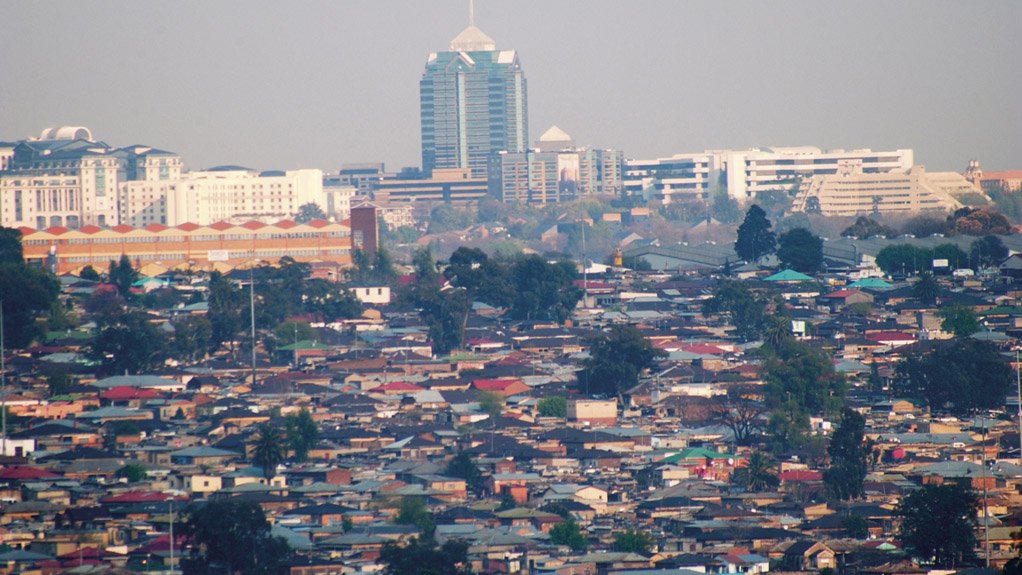
Asked during a Budget media briefing specifically about the City of Johannesburg, which is facing financial and operational Finance Minister Enoch Godongwana indicated that a direct intervention was likely.
However, he said the form that such an intervention could take had not yet been determined.
The reasons for municipal financial instability are identified in the review as being underpinned by weak revenue collection, poor credit control and a lack of financial discipline.
These weaknesses are being amplified by rising electricity and water input costs. But the accumulation of arrear debt owing to entities such as Eskom is attributed mainly to failures to bill accurately, collect revenue consistently, and ring-fence and remit collections for bulk services.
“These weaknesses have left 88 municipalities with unfunded budgets and limited capacity to maintain infrastructure and sustain services.”
ESKOM DISTRIBUTION AGENCY AGREEMENTS
Government has endorsed Distribution Agency Agreements (DAAs) to empower Eskom to take over electricity distribution on behalf of defaulting municipalities to ensure revenue is collected, current accounts are paid and service reliability is restored.
It has also written to 15 of the 71 municipalities that have signed up for its debt-relief programme, but which are not meeting the conditions, to enter into DAAs with Eskom or face being excluded from the scheme and becoming vulnerable to Eskom direct credit control mechanisms.
The National Treasury says a combination of targeted investment in revenue infrastructure, performance-based grant reforms, and long-term financial planning support will be pursued to improve municipal self-reliance and fiscal sustainability.
At the legislative level, the MFMA Amendment Bill is scheduled for public comment in early 2026, with the aim of strengthening monitoring and intervention tools.
Under Phase 2 of Operation Vulindlela, an initiative that has overseen reforms to stabilise electricity supply and restore key freight logistics services, reforms are under way to shift to a utility model for water and electricity, with these services run like businesses accountable to government and the public.
In his Budget speech, Godongwana argued that revenue collected for a specified function should be used primarily to sustain that function before any cross-subsidisation took place.
“In reality, this principle is consistently flouted. For instance, Johannesburg’s water revenue is R11.9-billion but only R1.3-billion is allocated to Joburg Water for capital expenditure. This has contributed to the massive backlog of R64-billion that is needed to fix water supply problems in the city,” he said.
To address the delivery crisis in struggling municipalities, the Budget Review adds that infrastructure projects funded by conditional grants will be delivered by implementing agents such as the Development Bank of Southern Africa, or the relevant district municipality where capacity exists.
If municipalities are capable, however, they will continue to manage their own conditional grants.
A performance-based grant is also being implemented under the Metro Trading Services Reform.
Seven qualifying municipalities have secured grants to strengthen management accountability, financial transparency, cash flows and infrastructure maintenance and R27.7-billion has been allocated to the programme for the coming three years.
Local government has been allocated R182.3-billion in 2026/27, to be transferred in the form of the equitable share (R110.1-billion), conditional grants (R54.7-billion) and general fuel levy sharing with metros (R17.5-billion).
EMAIL THIS ARTICLE SAVE THIS ARTICLE ARTICLE ENQUIRY FEEDBACK
To subscribe email subscriptions@creamermedia.co.za or click here
To advertise email advertising@creamermedia.co.za or click here

