









JOHANNESBURG (miningweekly.com) – Last year, South Africa witnessed hydrogen fuel cell electric vehicle (FCEV) mobility in Johannesburg when B20 and G20 top-brass were chauffeured around Johannesburg in Toyota FCEVs courtesy of Valterra, which provides the platinum group metals (PGM) used by FCEVs to convert hydrogen into electricity.
Last month, South Africa’s President Cyril Ramaphosa held public discussions at the Abu Dhabi Sustainability Week with UAE President Sheikh Mohamed bin Zayed Al Nahyan, where he emphasised the massive energy opportunity that green hydrogen represents for an Africa with superior sun, prime wind corridors, fast-moving water and a great PGM endowment.
Last week, Northam Platinum stated unequivocally that current world hydrogen developments are being under-estimated given the "incredible" hydrogen developments that Northam witnessed first-hand on a recent visit to China.
This week, hydrogen compression specialist PDC Machines made a point of reminding South Africa that it was PDC compressors that enabled the world’s largest hydrogen-powered ultra-heavy mining haul truck to do its rounds at Valterra Platinum’s Mogalakwena PGM mine in Limpopo province in full view of Mining Weekly and the world.
This reminder popped up during Engineering News & Mining Weekly’s Zoom interview with Mike Ciotti, the head of product at PDC Machines, and also Dr Sakib Khan, the GM for Africa of PDC Machines. (Also watch attached Creamer Media video.)
It was during this interview that Africa’s hydrogen mobility build-out began to be spelt out in much greater detail, with PDC positioning its high-pressure diaphragm compression as a backbone of the hydrogen mobility build-out.
Ciotti noted that while hydrogen is currently enjoying a policy and investment surge, PDC’s involvement dates back several decades. The company, founded in 1978, initially focused on high-pressure applications for toxic gases and nitrogen.
By the 1990s, as industrial gas companies began demonstrating fuel cell mobility concepts, compression requirements shifted sharply upward.
Applications moved from typical 150 bar to 200 bar systems to 350 bar, and ultimately 700 bar fuelling pressures, driven by the need to increase hydrogen storage density in vehicles.
Engineering News & Mining Weekly: Why do you believe that diaphragm compression is so well positioned for hydrogen applications?
Ciotti: The diaphragm compressor is just naturally mated to hydrogen, because it's able to contain the hydrogen with its static seals, and it's able to attain high pressures. Some of the pressures that we see today are 700 bar fuelling stations that require up to 1 000 bar hydrogen storage, and hydrogen, being the smallest molecule, is very susceptible to leaks, so the diaphragm compressor is able to contain that well within its static seals and achieve very high pressures.
FROM PILOT STATIONS TO SCALABLE HUBS
According to Ciotti, hydrogen refuelling station (HRS) deployment typically follows a staged approach.
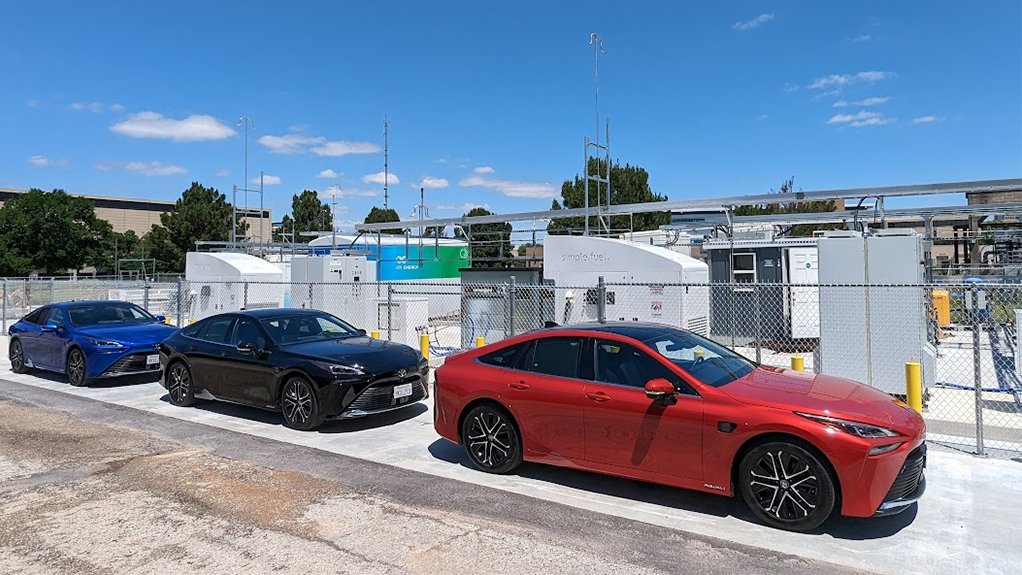
Early projects are small-scale demonstrations serving one or two vehicles consuming between four and ten kilograms of hydrogen a day. For this segment, PDC developed integrated systems combining electrolysis, diaphragm compression, storage and dispensing under its SimpleFuel platform.
As fleets expand, compression capacity and hydrogen supply strategy evolve. In many early deployments, hydrogen is trucked in via tube trailers at pressures ranging from 180 bar to 500 bar, depending on geography. Larger compressors are then used to boost pressure to storage and dispensing levels.
Scaling further introduces wide variability in hydrogen demand. Passenger vehicles typically require four to six kilogrammes per fill, buses between 20 kg and 30 kg, while heavy-duty trucks or mining vehicles may require 50 kg to 80 kg per fill. Compression systems must therefore accommodate both high pressures and higher throughputs to replenish storage quickly and maintain uptime.
The evolution of hydrogen production technologies is also reshaping compression requirements. While liquid hydrogen systems operate at low pressures of five to ten bar, proton exchange membrane (PEM) electrolysers commonly deliver hydrogen at around 30 bar. PEM electrolysers make use of PGMs such as platinum itself and iridium.
Emerging technologies, including solid oxide systems, may deliver hydrogen close to ambient pressure, significantly increasing compression ratios and stage requirements.
This shift, has compelled PDC to develop a broader portfolio capable of handling varying inlet pressures and higher flow rates as projects move toward industrial-scale hydrogen production.
ANCHORED DEMAND KEY TO AFRICAN SCALE-UP
Engineering News & Mining Weekly: What do you believe must happen over the next five years for hydrogen refuelling infrastructure to scale meaningfully in Africa?
Khan: In the early stages, the scale will be coming from mining fleets, heavy duty freight corridors, municipal bus depots. These are all concentrated and give a bankable offtake with the first wave of stations already being mapped out. So therefore, to move from concept to steel in the ground, we believe three things must align in Africa for this to happen. The first is some form of blended finance. Early deployments will require development finance institutions and strong partnerships to derisk projects and crowd in private capital. Secondly, compression is central to the uptime, safety and economics of hydrogen refuelling, I think many of your readers and viewers are probably aware of the mining truck that was deployed at Mogalakwena. It's interesting to note that the compression of the hydrogen was actually carried out by PDC compressors for that particular project. And lastly, certification of equipment must be aligned to international standards.
To move from concept to implementation over the next five years, the three elements must align.
“South Africa and Africa do not need 500 hydrogen refuelling stations tomorrow. We need the first five or ten executed correctly – technically sound, properly certified and financially structured. Once those are proven, scale becomes financeable,” Khan pointed out.
PHASED LOCALISATION
With South Africa’s established mining, petrochemical and industrial engineering base, localisation forms a core part of PDC’s Africa strategy.
The first phase focuses on local integration, leveraging domestic capability for civil works, electrical balance-of-plant and site commissioning. Emerging hydrogen-focused companies can also be incorporated into skills and technology transfer programmes.
The second phase envisages deeper system integration and selective assembly partnerships, while maintaining alignment with PDC’s global safety and performance standards. Over time, this model aims to build hydrogen-specific competence locally while ensuring adherence to international hydrogen safety frameworks and high-pressure testing standards.
“When global OEM excellence is aligned with South African industrial capability, we are building more than a project. We are establishing a durable hydrogen infrastructure platform for the region,” Khan emphasised.
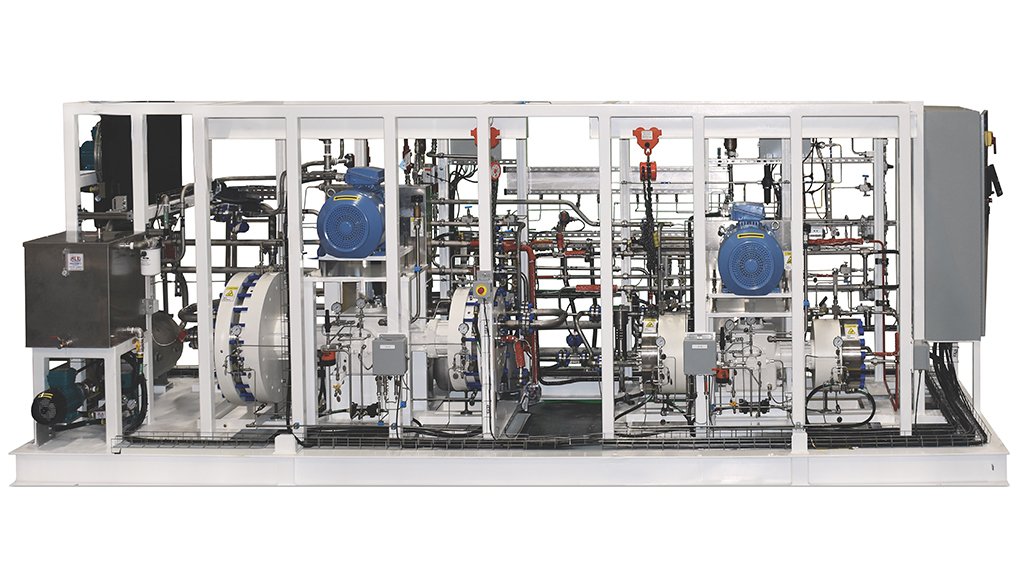
PDC Machines diaphragm compressors are ideal for a wide-range of ultra-pure gases including hydrogen, delivering leak-tight, contamination-free compression. PDC provides fully customised solutions ranging from bare compressor blocks to complete skidded or containerised systems engineered for demanding hydrogen applications.
EMAIL THIS ARTICLE SAVE THIS ARTICLE ARTICLE ENQUIRY FEEDBACK
To subscribe email subscriptions@creamermedia.co.za or click here
To advertise email advertising@creamermedia.co.za or click here

