





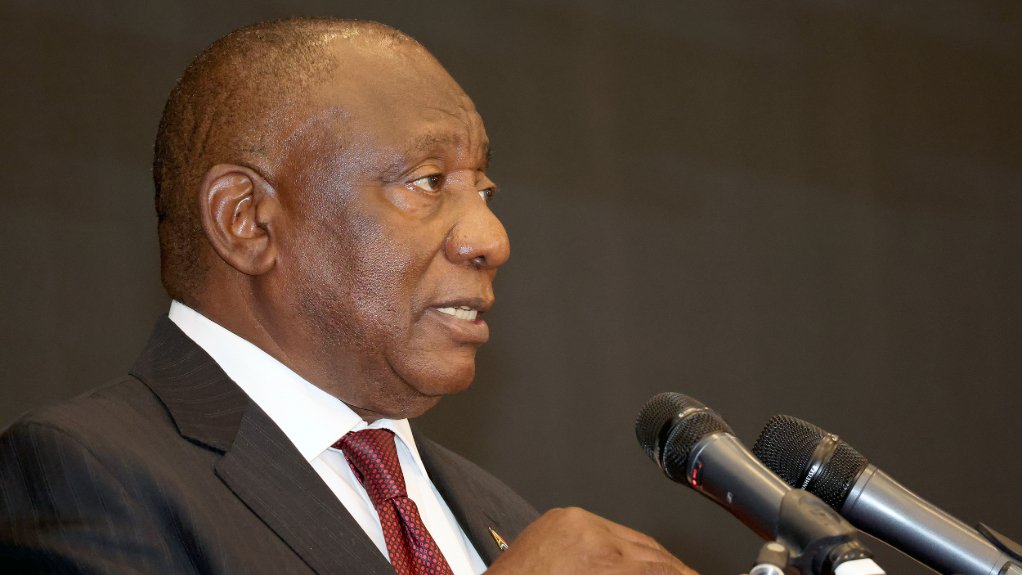
South Africa is seeking to expand its electricity transmission grid, which wis a R450-billion challenge, President Cyril Ramaphosa said in his keynote address at the 2026 Africa Energy Indaba, at the Cape Town International Convention Centre, on March 4.
"The main focus in our country has really been the energy landscape and the reform thereof," he told the assembled delegates. "Electricity is an absolute necessity in the lives of all South Africans. Today, 93% of South African households have electricity."
However, the bulk of his address was concerned with Africa as a whole.
"The ambition to be greater is there, but what holds us back is lack of energy," he pointed out. "Without energy, the broader aspiration of development, of the integration, of the African continent, of access and inclusion, cannot be achieved."
Not that the continent lacked energy potential. It had many and large-scale energy resources, of many types, including 60% of the world's total solar potential. Further, it also had substantial critical mineral resources, needed by many modern technologies, including energy systems.
Yet the continent suffered from energy poverty, with 600-million Africans still having no access to electricity. "This energy gap exists in a context of a growing population."
Africa's aim was to be able to meet its energy needs, with affordable and sustainable energy, which allowed development, while also being resilient and competitive in the export of energy, he affirmed.
"Energy is not a luxury; it is a must," he asserted. "Without energy, the broader aspiration of development, of integration, of the African continent, of access and inclusion, cannot be achieved."
It was also a matter of equity and equality. It could not be allowed that so many Africans had no access to electricity. This was an issue that needed urgent attention. Electricity allowed development, job creation and improved lives. When the continent talked about energy, it also needed to talk about industrialisation.
"Africa's energy agenda must be linked to an industrial agenda," he stressed. "When this continent speaks about critical minerals, it must also speak about beneficiation [and] value-addition."
Developed countries have agreed that minerals should be beneficiated in the countries that produce them, he noted. For the energy transition in Africa to be just and inclusive, it had to support industrialisation and development. "The energy transition must be just!"
African countries needed to develop together, he emphasised. Energy integration was an objective of the African Union and was a necessity.
"Across Africa, the logic of integration is visible in regional power pools " he cited. "It's already happening. An integrated system allows resources to be used more efficiently." Such a system would also allow more competitive electricity markets and spread risk.
Such large-scale infrastructure projects required significant financial instruments that were aligned with long-term national development policies, as they involved substantial upfront investment and long-term stable returns. This required long-term policy stability.
Few African countries could afford to finance these projects with public funds, but public money could have a catalytic effect. The private sector and international financial institutions were essential.
"Africa can no longer be left behind," affirmed Ramaphosa. "We cannot be a stepchild any longer!"
MIDDLE EAST IMPACT
The President also reflected on the heightened volatility in global energy markets in light of the war in the Middle East, which had resulted in the Strait of Hormuz – an important maritime trade route for cargo and oil and gas shipments – being inaccessible.
"Africa is already experiencing the impact of the escalating conflict in the Middle East, which strains supply chains and [contributes to] higher energy prices. As we have seen with Russia-Ukraine and during the Covid-19 pandemic, shifting geopolitical sands underscore the vulnerabilities of import-dependent economies across Africa.
"These vulnerabilities sharpen the case for regional and continental energy security and diversification. As such, this indaba is timely and strategic. It is an opportunity to position our continent in a rapidly-changing geopolitical context. Africa has what it needs to succeed. It has resources. It has people. It has growing institutions and expanding cooperation.
"The remaining task is to match this potential with sustained implementation, to translate plans into projects, and to turn projects into reliable power that supports industry, jobs and dignity," he said.
EMAIL THIS ARTICLE SAVE THIS ARTICLE ARTICLE ENQUIRY FEEDBACK
To subscribe email subscriptions@creamermedia.co.za or click here
To advertise email advertising@creamermedia.co.za or click here

